
Sabres Activate Michael Kesselring From Injured Reserve
Oct. 28: Kesselring will make his Sabres debut tonight and come off injured reserve, Ruff confirmed to Rachel Lenzi of The Buffalo News.
Oct. 27: The Buffalo Sabres have assigned defenseman Zach Metsa to the AHL’s Rochester Americans. The move will open the roster space to activate defenseman Michael Kesselring off of injured reserve. Head coach Lindy Ruff said he expects the team to make that roster move before Tuesday’s game against Columbus, as long as all goes well in the morning.
Kesselring has missed the first nine games of the season with a lower-body injury sustained in an October 1st preseason game. The injury delayed his debut with the Buffalo Sabres after joining the team alongside Josh Doan in the June trade that sent JJ Peterka to the Utah Mammoth.
That trade will be top of mind as Kesselring prepares for his first regular-season game in the blue and gold. Doan has already wowed fans with his early-year performance, netting six points and already rivaling a top-line role. But at the time of the move, many expected Kesselring to have a bigger impact in Buffalo after he proved to be a capable top-four defender in Utah.
Kesselring played in all 82 games of Utah’s inaugural season. He received the lowest average ice time (17:41) among a heavily-rotated Hockey Club defense, but routinely faced challenging roles alongside top defenseman Mikhail Sergachev and against top competition. He was strong on both sides of the puck, showing off a strong stick, lightning-quick speed, and heads-up passing. Those talents led Kesselring to 29 points on the year, the second-most on Utah’s blue line behind Sergachev (53).
Kesselring looked similarly capable in his rookie season of 2023-24. He finished that year with 21 points in 65 games, while operating from a third-pair role with the Arizona Coyotes. With two years of improvement to start his career, he now seems well-poised to bear some more responsibility with the Buffalo Sabres. Buffalo has relied on Conor Timmins and Metsa to fill the right side behind captain Rasmus Dahlin. Timmins has faired pretty well in the second-pair role, recording three assists and 24 blocked shots in nine games. Metsa has been less productive, with no scoring and just two blocks in four games. Kesselring should step ahead of Timmins on the depth chart, placing him next to former first-overall pick Owen Power. Power’s sturdy defense could be a great match for the typically aggressive Kesselring.
Meanwhile, Metsa’s brief appearance in the NHL will come to an end. He played the first NHL games of his career this season, after starting the year with two pointless games with the Americans. Metsa led Rochester’s blue line with 46 points in 69 games last season. It was his second pro season. He posted 24 points in 54 games as an AHL rookie. The 27-year-old will look to return to his top role on the Rochester blue line, and could remain a call-up option should Buffalo face any more injuries.
Penguins Place Rickard Rakell On IR, Recall Ville Koivunen
10/27: Pittsburgh made Rakell’s move to injured reserve official on Monday evening.
10/26: The Pittsburgh Penguins have announced that Rickard Rakell underwent a successful procedure on his left hand this morning, and the forward is expected to miss 6-8 weeks recovering. Just last night Rakell took a puck to the hand vs Columbus, was clearly bothered, and did not return.
It is a very tough blow for the team, who have come out of the gates looking much better in 2025-26, facing serious pressure to push for the postseason for the aging legends on their roster. Rakell in particular, who has been revitalized in Pittsburgh, headlined by a career high 70 points last year, has also been off to a great start with 8 in 9 games.
In a corresponding move, the Penguins recalled Ville Koivunen, who has already bounced back and forth between the NHL and AHL so far. The skilled 22-year-old forward, acquired in the Jake Guentzel trade, did not appear on the scoresheet in 2 games so far with the Pens, but jumps out with 11 points in just 6 games so far with AHL Wilkes-Barre. Now he, along with 18-year-old Benjamin Kindel could be in order for a larger role with Rakell sidelined. Kindel however, is nearing his 10-game threshold as a rookie, and it will be interesting to see GM Kyle Dubas’ plan for their 11th-overall selection last summer.
In particular for Rakell, the ailment is also especially unfortunate as it means he will miss the 2025 NHL Global Series in his home country of Sweden, as the Pens take on Nashville in mid-November.
In a critical season for the Penguins as they continue to teeter between win-now for their iconic players, and turning toward the future, the club is already being tested. Yesterday it came out that Caleb Jones, who had been playing well early in his Pittsburgh tenure, will miss eight weeks. Now a star, in the form of Rakell, is set to be absent for a similar timeline.
Flyers Assign Jett Luchanko To OHL
For a second-straight year, Jett Luchanko‘s time with the Philadelphia Flyers is cut short after only four appearances. Earlier today, Anthony Di Marco of Daily Faceoff reported that the Flyers would be assigning Luchanko to the OHL’s Guelph Storm today, and Philadelphia subsequently confirmed the news.
Luchanko’s reassignment can’t be described as anything other than disappointing for the Flyers. The team drafted Luchanko with the 13th overall selection in the 2024 NHL Draft, and he surprisingly made the team’s roster out of training camp last year.
Still, with little expectations of him sticking around, the team assigned him to OHL Guelph after going scoreless in four games with a -3 rating. He was mostly productive in his return to Guelph, scoring 21 goals and 56 points in 46 games as the team’s captain. Unfortunately, the Storm finished with a 21-38-5-4 record, missing out on the playoffs.
After another year of growth, Luchanko again made the Flyers’ roster out of training camp, this time under a new head coach. This time around, his performance was arguably worse.
Again being reassigned after four games, Luchanko again went scoreless with a -3 rating. He averaged nearly five minutes less a night under Rick Tocchet, primarily centering the team’s fourth line when in the lineup. Despite being reassigned today, Luchanko hasn’t suited up for Philadelphia since October 20th.
There was some concern earlier in the year about returning him to Guelph, largely because the team wasn’t expected to be competitive this year. However, although it’s still relatively early in the 2025-26 campaign, the Storm are 6-5-2-0 through their first 13 games, holding onto the final playoff spot in the OHL’s Western Conference.
Luchanko made it apparent that he’s not ready for much responsibility at the NHL level. Although he is likely better suited for developmental time in the AHL, he has not yet reached the age where that is permissible. Still, given that the team signed Tocchet to a multi-year deal this offseason, there might be some concern about Luchanko’s overall future in the organization, given his subpar first impression.
Patrik Laine Out Three To Four Months
A tough start to the season for Canadiens winger Patrik Laine just got even tougher. The team announced that he has undergone surgery to repair a core muscle injury. As a result, he will miss the next three to four months.
This is Laine’s second season with Montreal after he was acquired from Columbus in the 2024 offseason. It’s also now the second straight season that he has sustained a significant injury early on. Last season, a preseason knee injury cost him a couple of months of action and this one could keep him out for twice as long.
While Laine got through training camp healthy this time, it didn’t take long for him to drop down the depth chart. While he started the year on Montreal’s second line, he was down to fourth-line minutes at five-on-five within a couple of weeks. As a result, he was limited to just one assist through five games while averaging just 12:36 per night, a career low in that regard. He didn’t accompany the team on their four-game Western road trip while getting a second opinion on his injury; clearly, that second opinion concurred with the first with him undergoing surgery soon after.
Last season, Laine made an immediate impact when he returned to the lineup, tallying 15 power play goals. In doing so, he was among the league leaders in that regard despite missing 29 games while he helped Montreal’s power play get closer to the middle of the pack. However, his playing time and effectiveness waned down the stretch and into the playoffs where he was injured partway through their series against Washington.
This is a contract year for Laine, who carries a cap charge of $8.7MM, tops among Canadiens forwards. It’s fair to say his hopes of a big payday next summer have taken another hit as he’ll now miss more than half the season; that, coupled with his struggles at full strength, don’t bode well for him on the open market. That said, because he should wind up missing 100 days because of this injury and has more than 400 career NHL appearances, Laine should be eligible for a one-year contract with performance incentives next summer. That might be the best route to go for him, one that would allow him to maximize his compensation should he stay healthy while providing the signing team – be it Montreal or someone else in free agency – with less risk in signing him.
For Montreal, since they have over $4MM in cap space at the moment per PuckPedia, an LTIR placement wouldn’t make any sense for them. Since Laine is expected to return this season, the maximum amount of LTIR space they could amass is $3.82MM, not his full cap charge so, barring a rash of further injuries, don’t expect him to be moved to LTIR. As of yet, the Canadiens haven’t moved him to regular injured reserve although that is merely a formality for whenever they need to open up a roster spot.
Golden Knights Sign Carter Hart To Two-Year Deal
Oct. 25: The Golden Knights have registered the contract, PuckPedia reports. The deal carries a $1.45MM signing bonus this season with a league-minimum salary of $775K. In 2026-27, Hart will make $1.775MM in salary with no signing bonus.
Oct. 24: Vegas will be converting Hart’s tryout into a two-year contract as expected. It’ll be worth $4MM with an average annual value of $2MM, Darren Dreger of TSN reports.
Oct. 16, 12:31 p.m.: The Golden Knights announced that Hart will be joining the organization, although there isn’t a guaranteed contract yet – he’ll begin his work on a tryout with AHL Henderson, Chris Johnston of The Athletic and TSN reports. Vegas’ full statement is as follows:
Following the reinstatement decision agreed on by the National Hockey League and the National Hockey League Players’ Association, goaltender Carter Hart will be joining the Vegas Golden Knights organization. The Golden Knights are aligned with the process and assessment the NHL and NHLPA made in their decision. We remain committed to the core values that have defined our organization from its inception and expect that our players will continue to meet these standards moving forward.
Oct. 16, 8:30 a.m.: The Vegas Golden Knights are nearing a deal with free agent netminder Carter Hart, insider Frank Seravalli reported on his Victory+ show yesterday. Seravalli said, “I’d expect Hart’s deal to be two years,” a bit north of the league-minimum salary.
Elite Prospects’ Cam Robinson seconded Seravalli’s report and provided a little more detail, stating that Hart’s deal is expected to be a two-year, $1.8MM AAV pact. Hart, who Wasserman’s Judd Moldaver reps, became eligible to sign an NHL contract yesterday but is not eligible to play until December 1st.
That Hart isn’t eligible to play until December is notable given a recent injury to starter Adin Hill during the team’s road win against the Calgary Flames two days ago. There has been no further update on Hill’s status, but since Hart remains ineligible to play for the next month and a half, the Golden Knights will have to look elsewhere to reinforce their position in the crease should Hill miss any time.
While no deal with Hart has been officially announced to this point, Vegas’ interest in Hart has been widely reported, even going back to September, when The Athletic’s Chris Johnston called the team a front-runner to secure the netminder’s services.
It was reported earlier that month that Hart would receive interest from multiple NHL teams, which is notable as the other four Hockey Canada players acquitted of charges this summer in connection to an alleged sexual assault have been met with more muted NHL interest.
Center Michael McLeod was at one point expected to sign a deal with the Carolina Hurricanes, but ultimately agreed on a three-year extension with Avangard Omsk of the KHL, the side he played for in 2024-25.
A month ago, Ottawa Senators GM Steve Staios commented that both his organization and forward Alex Formenton agreed that “a fresh start” would be the best option for both sides. Still, thus far, Formenton hasn’t been able to secure another NHL team to play for. He is currently playing out a four-month contract (that contains an option to extend for the rest of the 2025-26 season) with Swiss National League side HC Ambri-Piotta.
The final two players involved in this past summer’s trial, defenseman Cal Foote and forward Dillon Dube, remain free agents. Foote spent 2024-25 with HK 32 Liptovsky Mikulas of the Slovak Extraliga, while Dube played for Dinamo Minsk in the KHL. There has not yet been much reporting indicating serious NHL interest in either player. The only notable report that was issued regarding either player came from The Fourth Period’s David Pagnotta, who noted that the Toronto Maple Leafs would not be interested in signing Dube.
As a result, it appears Hart is, by far, the most likely candidate of this group of players to receive an NHL contract in the short-term future. Hart is also, among the group, arguably its most accomplished NHL player.
The 27-year-old was once one of the more promising goalies in the sport, playing to solid results (.906 career save percentage across 227 games) for the Philadelphia Flyers. While the Flyers mostly struggled during Hart’s tenure, especially later on, he did backstop them on one playoff run, posting a .926 save percentage in 14 games during the 2019-20 season. That Flyers team fell in seven games to the New York Islanders in the Eastern Conference semifinals.
In Vegas, Hart would potentially have the opportunity to get a real chance to play games for one of the NHL’s leading Stanley Cup contenders. The Golden Knights, who currently sit first in the Pacific Division with a 2-0-2 record, are loaded with high-end veteran talent, including center Jack Eichel, defenseman Shea Theodore, and wingers Mitch Marner and Mark Stone.
Hill, the team’s starter, backstopped the team to its first-ever Stanley Cup championship in 2023, but the 29-year-old doesn’t have an extensive resume as a number-one goalie. While he started to achieve real success on a Stanley Cup-winning team, he has also made 50 starts in a season just once in his career.
Whether Hart has a path to being Vegas’ long-term number-one goalie is unclear at this stage.
Hill was signed to a six-year, $6.25MM AAV contract extension in March, signaling the Golden Knights’ commitment to him as their top netminder moving forward. But the Golden Knights have shown a willingness to make aggressive moves to maximize their competitive chances in the past, especially in net, such as when they acquired and extended netminder Robin Lehner despite the presence of Vezina winner Marc-Andre Fleury on their roster.
As a result, assuming Hart does sign in Vegas, and assuming he can play well upon his return to the NHL, a potential long-term future in Vegas cannot be counted out, even though Hill has signed that hefty extension. If the Golden Knights feel, down the line, that Hart gives them the best chance to win long-term, everything they have done and accomplished as an organization thus far suggests they won’t hesitate to re-sign Hart, even with Hill signed. Worth noting here is that under the reported terms of Hart’s expected contract (two years, $1.8MM AAV), Hart would become eligible to sign a contract extension on July 1st.
Bringing that up may be getting a little bit ahead of things, though, as the reality is Hart has not played competitive hockey since he left the Flyers in January of 2024. While he was once seen as a promising young netminder, it’s difficult to project how a player will perform, especially a goalie, after missing so much time. The Golden Knights, though, based on all of the available reporting, clearly believe in Hart’s NHL future, and appear poised to sign a two-year contract with the player that reflects that belief.
Photo courtesy of Eric Hartline-USA TODAY Sports
Canucks Acquire Lukas Reichel
The Canucks announced Friday that they’ve acquired forward Lukas Reichel from the Blackhawks in exchange for a 2027 fourth-round pick. They announced shortly before the move that center Teddy Blueger has been placed on injured reserve, retroactive to Sunday, as the corresponding transaction.
It is not at all the return on investment Chicago hoped for when they made Reichel the 17th overall pick of the 2020 draft. Now 23, Reichel made his NHL debut in 2022, amid a spectacular rookie season in the AHL that saw the German forward notch over a point per game with the Rockford IceHogs. Reichel got a more extended look in Chicago’s lineup the following season and looked like the future top-six fixture they hoped he’d be. He turned in seven goals and 15 points through 23 games, averaging 16:22 of ice time per night and leading the team in points per game among players who finished the season in the organization.
Once Reichel first broke camp with the Blackhawks in 2023-24, though, the regression was quick and steep. Reichel was initially slotted as the No. 2 center behind Connor Bedard, but that experiment ended quickly as he was getting caved in defensively and barely generating offense. He finished the season with just five goals and 16 points in 65 appearances and was sent back to Rockford later to boost his confidence, managing three goals and 12 points in 14 combined regular-season and playoff games.
Last year was a slight improvement, but not enough to truly boost his standing in the organization. He was still an occasional healthy scratch and saw his ice time slashed to under 12 minutes per game, although he did make a career-high 70 appearances. That came with a slight bump in offense in his reduced role, managing an 8-14–22 scoring line, but he still had negative defensive impacts and won just 39.9% of his faceoffs as he spent most of the year down the middle. That turned into Chicago making Reichel available for trade over the offseason and even mulling placing him on waivers late in training camp, but he stuck with the team on opening night.
Reichel was scratched for three of the Blackhawks’ first four games but played in four straight to end his tenure in Chicago. That streak included a two-goal, three-point effort against the Blues back on Oct. 15 in a season-high 13:11 of ice time. That gives him four points in five games on the year, all at even strength, despite averaging under 10 minutes per game.
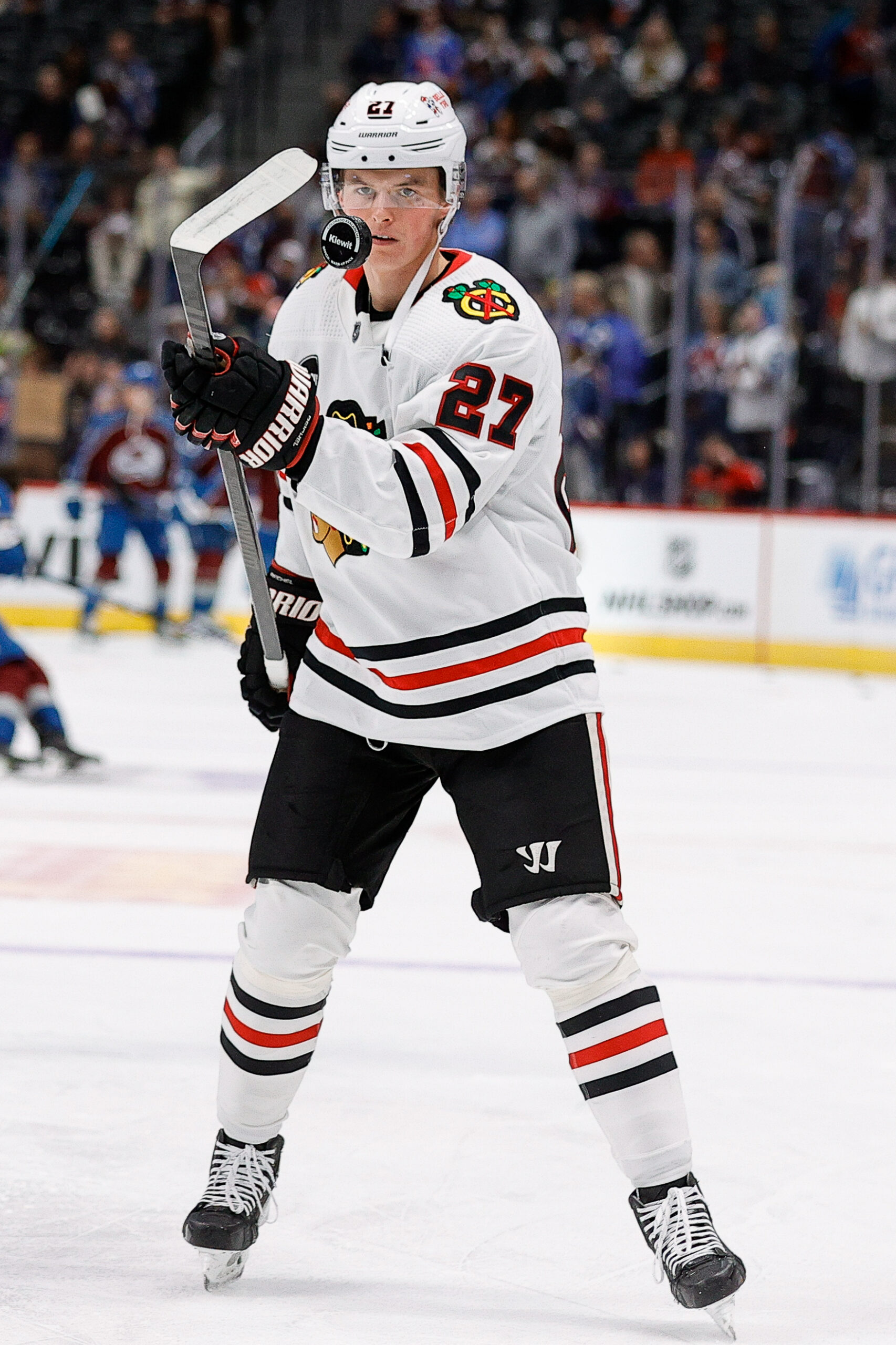 That’s an intriguing taste of the upside Vancouver is now betting on. While a natural left-winger, Chicago tried Reichel at center multiple times. With the Canucks’ depth issues down the middle behind Elias Pettersson and the oft-injured Filip Chytil, it stands to reason they’d prefer to keep Reichel down the middle. Since Chytil is currently out of the lineup with an upper-body injury, there’s a prime opportunity for Reichel to have his leash removed and immediately jump into a second-line role on a trial basis, likely between veterans Jake DeBrusk and Brock Boeser.
It’s a no-risk pickup for Vancouver, who can walk away from Reichel next summer if he doesn’t pan out by not issuing him a qualifying offer. He’s in the back half of a two-year, $2.4MM deal he signed with Chicago in 2024 that carries a cap hit of $1.2MM.
Blueger has been placed on IR with an undisclosed injury in a corresponding move. That designation is retroactive to Ocotber 19th, which will force Blueger out of Vancouver’s Saturday matchup against the Montreal Canadiens. He could be activated ahead of Sunday’s game against the Edmonton Oilers, though that would require the canucks to send another player to the minor-leagues. Blueger scored one goal in two games before falling to injury. He has been a core piece of Vancouver’s fourth-line for the last two seasons, and should slot back into the lineup as soon as he’s back to full health.
The Canucks are currently carrying Arshdeep Bains and Joseph LaBate as their extra forwards. Both players would require waivers to be sent to the AHL. Extra defenseman Tom Willander would not require waivers, though Vancouver could want to avoid reassigning one of their top prospects before awarding him with his NHL debut.
Photo courtesy of Isaiah J. Downing-USA TODAY Sports.
Joseph Woll Returning To Maple Leafs From Personal Leave
The Maple Leafs announced Friday that goaltender Joseph Woll will begin the return-to-play process after missing more than a month while on personal leave. He was retroactively placed on long-term injured reserve yesterday and will remain there until the club’s doctors clear him to return to game action.
Woll took an indefinite leave of absence to deal with a family matter less than a week into training camp. He never entered the NHL/NHLPA Player Assistance Program during his absence, so his return can be managed entirely at the team’s discretion. The team clarified at the time that Woll’s absence was not substance-abuse related but did not issue any further comment.
Having Woll’s return on the horizon is a welcome sight. The Maple Leafs haven’t gotten great performances out of starter Anthony Stolarz or waiver claim Cayden Primeau in his absence. Stolarz has seemingly struggled with a higher-than-normal workload, starting six of seven with a 2-3-1 record, .894 SV%, and 3.01 GAA. Those below-average numbers translate to a similarly unimpressive -1.6 goals saved above expected figure, per MoneyPuck. That’s still not as subpar as the -1.7 GSAx that Primeau put up in his lone appearance, a 7-4 win over the Predators on Oct. 14 that saw him allow four goals on 30 shots.
Meanwhile, the 27-year-old Woll has yet to have a below-average showing in any of his four NHL seasons. He was especially excellent last year, starting a career-high 41 games with a 27-14-1 record, .909 SV%, 2.73 GAA, and 16.8 GSAx. He was 11th in the league in that latter stat, proving his three-year, $11MM extension he signed in 2024 to be one of the better-value deals among goaltenders.
Getting that type of play out of Woll in his return would help buoy a Maple Leafs club that’s struggled on both sides of the puck to begin 2025-26. The team ranks in the bottom half of the league in both shots for and shots against per game, although above-average finishing still has them scoring 3.43 goals per game for 10th in the NHL.
Rangers Recall Brennan Othmann
The Rangers announced they’ve recalled Brennan Othmann from AHL Hartford. The winger will get his first look of the season on the NHL roster amid reports he’s been made available for trade. They’ve had an open roster spot since sending defenseman Scott Morrow down to Hartford at the beginning of the week, so no corresponding move is required.
While the recall could serve as a showcase to help boost the struggling prospect’s trade value, that’s not its primary purpose. The Rangers are down a forward after Matt Rempe sustained an upper-body injury in his fight Thursday night with the Sharks’ Ryan Reaves. Othmann ensures they continue to have a healthy extra forward in Rempe’s absence, however long that may be.
It’s likely that nothing so far this season has changed the Rangers’ mind that a change of scenery is the best outcome for Othmann, who they selected No. 16 overall in the 2021 draft. In four games with Hartford, he’s been limited to one assist and an even rating. While he hasn’t demonstrated much upside in his NHL call-ups thus far, only managing two assists in 25 games, he’s at least had some productive runs with Hartford, including 12 goals and 20 points in 27 games last year. An AHL scoring slump certainly won’t do good things for his trade value.
Presumably, the Rangers feel Othmann and his 6’0″, 192-lb frame are a better fit for a bottom-six role than late camp cuts like top prospect Gabriel Perreault, who’s managed a goal and an assist in four games for Hartford. They’ve had no prior hesitancy in dropping him into third or fourth-line jobs. He’s only averaged 9:52 of ice time per game in his NHL career while recording a plus-seven rating and 49 hits. While he’s been a semi-effective physical presence, he’s failed to show he can convert the high-end finishing ability he displayed in juniors (and in Hartford, to some extent) into NHL minutes. He’s yet to score on 26 shots on goal.
He’ll now get one of his last chances to change that track record in New York. It could be an extended one depending on the severity of Rempe’s injury. The pending restricted free agent will join a battle for playing time with Jonny Brodzinski and Juuso Pärssinen. Every other active Rangers forward has appeared in all nine games so far this season.
Golden Knights Place Mark Stone On Long-Term Injured Reserve
Oct. 23: Stone’s IR placement has turned into an LTIR placement, per PuckPedia. They were short on cap space after recalling Carl Lindbom and Jaycob Megna from AHL Henderson on Wednesday, so this was the expected outcome. With an additional $3.82MM in their LTIR pool, they now have just under $2.5MM in cap space following the recalls. Since the placement is retroactive to Oct. 18 and he needs to miss at least 10 games and 24 days before he’s eligible to return, the soonest he’ll be back is Nov. 13 against the Islanders.
Oct. 21: Stone landed on injured reserve last night, per Danny Webster of the Las Vegas Review-Journal. It’s purely a formality; a week-to-week designation ensured he’d missed the seven days required for IR. Vegas now has an open roster spot, but there’s only $310,275 remaining in their LTIR pool, according to PuckPedia. That doesn’t leave them enough room to make a corresponding recall unless they play short a skater for a game, allowing them to use an emergency exception and temporarily exceed the cap by recalling a player with a cap hit of $875,000 or less.
Oct. 20: Vegas Golden Knights head coach Bruce Cassidy announced that winger Mark Stone is out week-to-week with a wrist injury in a Monday press conference, per Jesse Granger of The Athletic.
Stone fell face-first into the boards and briefly returned to the locker room in Vegas’ Thursday win over the Boston Bruins. He remained in the lineup and scored four points in Saturday’s win over the Calgary Flames, but appeared to take another awkward fall midway through the third period, also captured by Granger.
It’s not clear if either fall is connected to Stone’s injury. He’ll be forced out of the short term, leaving Vegas with a big hole in their top six. Stone ranks second on the team and across the NHL, scoring 13 points in six games. He has found a comfortable role next to scoring leader Jack Eichel and winger Ivan Barbashev, forming a top line that’s outscored opponents five-to-three at even-strength.
Stone has long been among Vegas’ best players but struggles with routine injury. He has missed 170 games across six full seasons with the Golden Knights, or roughly 35 percent of a possible 492 games. He’s also averaged 26 goals and 80 points per 82 games played in that period. That productivity and a lofty impact on defense make Stone a standout whenever he’s in the lineup. Now, Vegas will have to push through at least a few games without that difference-maker.
In Stone’s absence, Vegas will likely turn towards Brandon Saad or Reilly Smith to fill a top-six winger role. Smith has one point, while Saad hasn’t scored through six games this season. More pressingly, Stone’s absence should give Shea Theodore a chance to return to the top power-play unit. Vegas has been operating with five forwards on their top unit, thanks to Pavel Dorofeyev‘s five power-play points to start the year. That’s left Theodore with just five minutes of ice time and no scoring on the power-play. Vegas could also turn towards William Karlsson, who has one power-play point and three total points in six games.
Predators Assign Brady Martin To OHL
The Predators announced Wednesday that they’ve assigned center Brady Martin to the OHL’s Soo Greyhounds. They now have two open roster spots, although roster considerations aren’t playing a factor in this move.
Martin, 18, has seen his stock rise more than most prospects over the past year. Viewed as a late first-round selection early in 2024-25, he rocketed his way up draft boards enough to earn the call at fifth overall from Nashville. That was fueled by an offensive explosion in juniors from the physical pivot, who produced 33 goals and 72 points in 57 games for the Greyhounds after recording just 10 goals and 28 points in 52 games the year prior.
That carried over into the preseason, where Martin converted a two-goal, one-assist performance in four games into a spot on Nashville’s opening roster submission. Initially, it looked like he would get quite a long leash. Martin started the opener on the top line with Filip Forsberg and Ryan O’Reilly, but only factoring in at even strength meant he only averaged 12:42 of ice time through a pair of games, recording an assist and an even rating, before the Predators scratched him in what they referred to as a preset development plan. Martin ended up sitting in the press box for four straight before re-entering the lineup for last night’s loss to the Ducks. He only skated 10:51 but managed his first two career shots on goal, along with one block and going 2-for-6 on faceoffs.
Yet Martin, still a raw prospect, needs playing time more than anything else. He’ll get that now in spades in Sault Ste. Marie, where he’ll be their top skater and should aim to be among the OHL’s leading scorers at season’s end, at least in terms of points per game. The demotion to the Greyhounds is permanent for the remainder of 2025-26, save for an extremely rare emergency exception in a catastrophic injury situation or until the Soo’s season comes to an end.
Martin still checks in as the Preds’ No. 1 prospect and is the highest-ceiling middle-man they’ve developed in-house in years. After another close-to-full season of development in juniors, he’ll be given plenty of leeway to secure a more permanent slot in Nashville’s forward group to begin the 2026-27 campaign.
Since Martin played fewer than 10 games before being sent back to juniors, his entry-level contract will not take effect this season and will not count toward Nashville’s 50-contract limit. He is now on track to reach restricted free agency in 2029 with an additional four years of team control after that. He still earns his $97,500 signing bonus for 2025-26, bringing his cap hit down from $975,000 to $942,500 for next year.
A corresponding recall in the coming days should still be expected. With Martin no longer in the picture, the Predators aren’t carrying any extra forwards with them. As things stand, they’ll need to dress 11 forwards and seven defensemen against the Canucks tomorrow if Jonathan Marchessault, who’s missed the last two games with a lower-body issue, can’t play.