
Predators Recall Adam Wilsby From AHL
After another short stay in the American Hockey League, Adam Wilsby is back in the NHL. The Nashville Predators announced they have recalled the young defenseman from their AHL affiliate, the Milwaukee Admirals, before their game tomorrow against the Winnipeg Jets.
Wilsby has already been on the Predators’ roster for an extended stay. The organization recalled him on November 13th before their Pacific Division road trip although he never factored into the lineup. He may make his NHL debut this week, especially considering how Nashville has played recently.
The West Coast road trip went unfavorably, with a 1-2-1 record, and Wilsby’s introduction into the lineup would provide a different look. According to MoneyPuck, the defensive pairing of Jeremy Lauzon and Alexandre Carrier has provided a dismal 40.8% xGoals%, and the Predators would be wise to switch things up with their second pairing.
West Notes: Predators, Gourde, Daccord
Sportsnet’s Elliotte Friedman believes that the Nashville Predators aren’t looking to move any of their three 2025 first-round picks. The news comes in as the team’s general manager Barry Trotz is reportedly shopping for a center as well as a top-four defenseman with some term left on their contract.
The Predators have had a disappointing start to the season and are currently sitting in the second-last spot in the Western Conference with a 6-11-3 record. The team had high hopes coming into the season after several high-priced free-agent acquisitions. However, it’s easy to see why Trotz is apprehensive to move out any first-round picks to try and salvage this season.
In other Western Conference notes:
- The Seattle Kraken reportedly want to keep forward Yanni Gourde in Seattle long-term (as per Elliotte Friedman of Sportsnet). The 32-year-old has had a slow start to the season with just two goals and five assists in his first 20 games, but that hasn’t deterred the Kraken, who love the player. Gourde is in the final season of a six-year $31MM contract he signed back in November of 2018 while he was a member of the Tampa Bay Lightning and would likely have a hard time matching that kind of deal in free agency. However, if the Kraken wants to keep the two-time Stanley Cup Champion in Seattle, he should still score a lucrative deal once again.
- Seattle Kraken goaltender Joey Daccord is receiving interest from two different countries for two different upcoming tournaments despite not being born in either country. Daccord was born in the United States but is reportedly receiving interest from Team Canada (as per Ken Campbell of The Hockey News) for the upcoming 4 Nations Face-Off. Daccord’s father was born in Montreal, Canada, while his mother was born in Switzerland, and he is apparently receiving interest from the Swiss team for the upcoming Olympics (as per Friedman). Daccord came out of nowhere last season, dressing in 50 games for the Kraken in his age-27 season. He put up strong numbers last year and has been even better this season, starting out the year with a 9-3-1 record and a .923 save percentage.
Evening Notes: Wilsby, Georgiev, Makar
The Nashville Predators have announced that they’ve sent defenseman Adam Wilsby to the Milwaukee Admirals of the American Hockey League. The 24-year-old had been up with the team since November 13th but didn’t see any NHL action. The fourth-round pick in 2020 is in his third professional season in North America and has dressed in 11 AHL games this year with Milwaukee, tallying a goal and two assists to go along with a +4 rating.
The Stockholm, Sweden native has yet to see NHL action in three seasons with the Predators organization but remains someone that team management is high on despite his lack of offensive production. Wilsby has impressed in the AHL with his skating, gap control, and defending in his zone and will likely see another call-up soon.
In other evening notes:
- Colorado Avalanche netminder Alexandar Georgiev took part in the team’s skate today and could be an option tomorrow in Washington depending on how he feels tonight and tomorrow (as per Evan Rawal of the Denver Gazette). The development suggests that Colorado is optimistic about the 28-year-old’s recovery and potential return to the lineup. The Avalanche badly need some better goaltending as the team has the worst save percentage in the entire NHL. Georgiev also has a vested interest in turning around the team’s fortune as he is just over seven months away from unrestricted free agency.
- Sticking with the Avalanche, David Satriano of NHL.com writes that defenseman Cale Makar is the early favourite to capture the Norris Trophy as the NHL’s top defenseman. NHL.com held a 15-person panel to vote on the early season winners and Makar came out ahead of Quinn Hughes and Josh Morrissey. Makar was the NHL’s First Star of the Month in October and began the season with an 11-game point streak that saw him register four goals and 15 assists. Makar is now up to eight goals and 19 assists in 19 games, which is a big reason Colorado has been able to keep pace in the Western Conference despite league-worst goaltending and a litany of injury issues.
Thomas Novak Returns From Injury
Originally announced in Elliotte Friedman’s ’32 Thoughts’ and expanded upon by Alex Daugherty of the Tennessean, the Nashville Predators are looking to buy. The Predators are looking to claw their way out of an early 6-10-3 record after spending $108MM on Steven Stamkos, Jonathan Marchessault, and Brady Skjei this past offseason.
The Predators have used a combination of Juuso Parssinen and Colton Sissons as the team’s second-line centers to unfortunate results. The two have combined for seven points this season and simply haven’t generated the offense required to keep them in the top six long-term. The defensive pairing of Jeremy Lauzon and Alexandre Carrier have combined for an abysmal 39.2% xGoals% according to MoneyPuck despite playing the most minutes of any defensive pair on the roster.
- Nashville could get a boost to their second line in the form of forward Thomas Novak who’s expected to return tonight after missing the team’s last six games (X Link). Novak has disappointed like many players on the Predators with three goals and four points in 13 games but is only a year removed from scoring 35 goals and 88 points in 122 games for Nashville.
Matt Irwin Announces Retirement
Unrestricted free agent defenseman Matt Irwin is stepping away from the game, the NHLPA announced. He confirms his retirement after 10 NHL seasons and 461 appearances.
“As I reflect on my career, I can’t help but feel incredibly grateful and fortunate to have lived out my childhood dream of playing in the NHL,” Irwin said in a statement released by the players’ association. “My success would not have been possible without the support of my family, my in-laws and especially my wife, Chantel, and two kids, Beckem and Lennon. You all pushed me to be the best version of myself on and off the ice.”
“I’m fortunate to have been surrounded by the best group of teammates that I could have possibly asked for,” Irwin continued. “Each and every one of them made coming to the rink the best years of my life. I hope our paths cross somewhere down the road.”
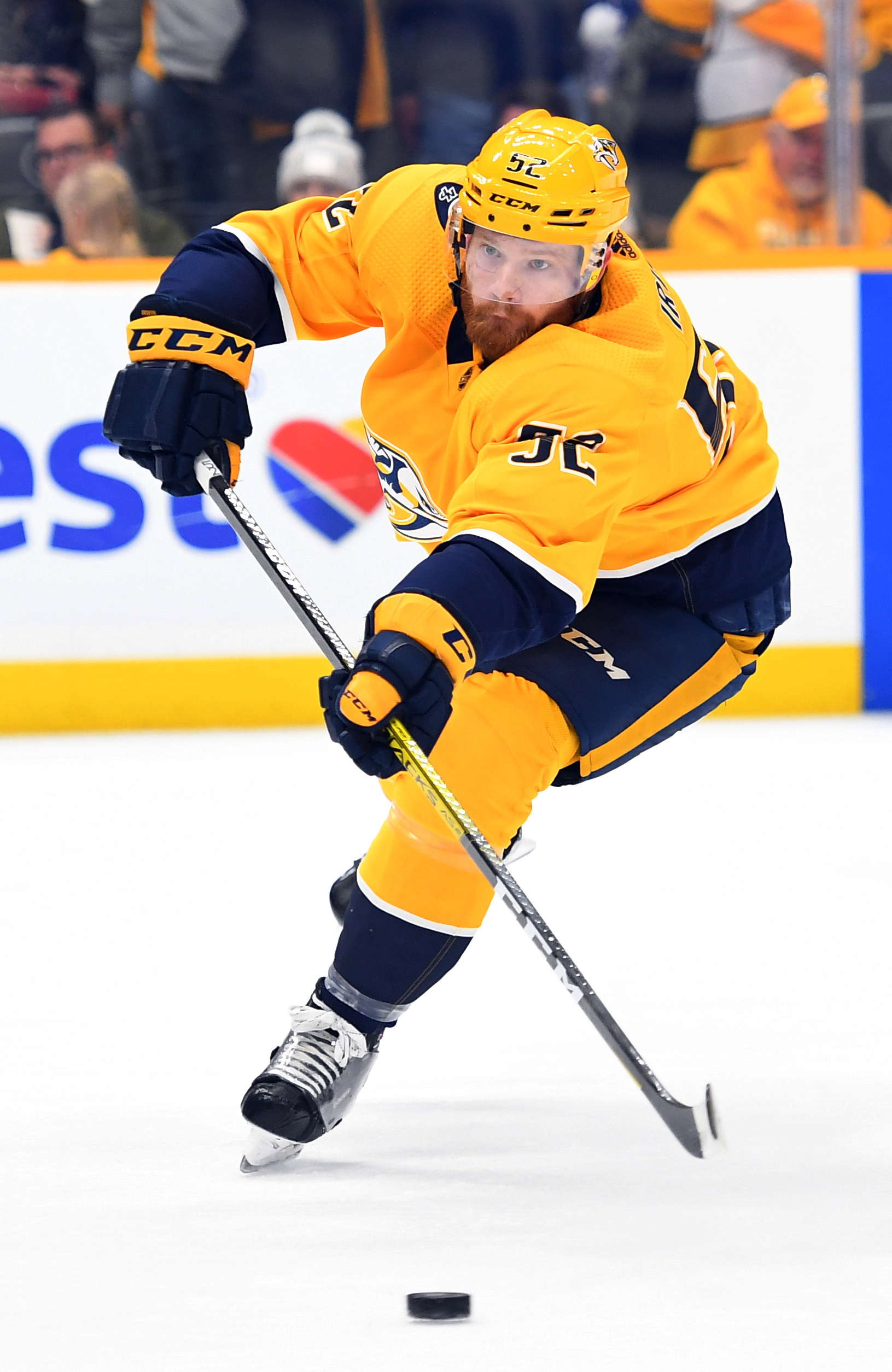 Now 36, Irwin never played major junior hockey and instead jumped straight from the junior ‘A’ BCHL to NCAA hockey with UMass. The left-shot defender spent two seasons there before signing as an undrafted free agent with the Sharks in 2010, kicking off his professional career.
Irwin spent two full seasons with San Jose’s AHL affiliate, then in Worcester, Massachusetts, before receiving his first NHL recall in 2012-13. He appeared in 38 of 48 games for the Sharks during the lockout-shortened season, recording 12 points and a -1 rating while averaging 19:06 per game and finishing 19th in Calder Trophy voting. Irwin also played in all 11 of San Jose’s playoff games as he got an audition in top-pairing minutes at even strength alongside Dan Boyle.
The Victoria, British Columbia native managed to stick around as a full-time NHLer for the following two seasons in the Bay Area but steadily saw his minutes reduced. After a 2014-15 campaign that saw him record a career-high eight goals, Irwin became an unrestricted free agent and signed with the Bruins.
However, Irwin only made two NHL appearances in a Boston sweater, instead spending nearly all of the 2015-16 season on assignment to AHL Providence. Understandably, he was one-and-done with the Bruins, and landed a deal with the Predators in free agency the following offseason.
It was the right choice for Irwin, who ended up playing 195 games in parts of four seasons in Nashville – the most of the six NHL franchises he appeared for. Aside from four appearances for AHL Milwaukee in 2016-17, Irwin managed to avoid being sent to the minors for the next seven years, sticking around in bottom-pairing/press box roles for the Predators, Ducks, Sabres, and Capitals.
Irwin’s last NHL games came with Washington in 2022-23. He recorded five points, a -8 rating and 36 PIMs in 61 games along with 75 blocks and 117 hits. He signed a two-way contract with the Canucks for 2023-24 but didn’t make the team, instead spending all of 2023-24 on assignment to AHL Abbotsford, where he recorded 16 points (5 G, 11 A) and a +2 rating in 65 games while serving as an alternate captain.
Irwin closes the book on his NHL career with 25 goals, 68 assists, 93 points, and a -9 rating in 461 games. He also logged 211 PIMs, 725 shots and a respectable 50.6 CF% at even strength while averaging 15:26 per game. He also appeared in 47 playoff games for the Sharks and Preds in 2013, 2014, 2017, and 2018, most notably playing in all 22 postseason contests as Nashville advanced to the only Stanley Cup Final in franchise history in 2017.
Irwin also logged 314 AHL appearances in parts of seven minor-league seasons, totaling 32 goals and 103 assists for 135 points. All of us at Pro Hockey Rumors extend our best wishes to Irwin in retirement.
Image courtesy of USA Today Sports.
Predators Recall Adam Wilsby
The Predators have recalled defenseman Adam Wilsby from AHL Milwaukee, Alex Daugherty of the Tennessean reports Wednesday. The 24-year-old replaces the roster spot vacated by Dante Fabbro, who was claimed off waivers by the Blue Jackets on Saturday.
Wilsby, a fourth-round pick in 2020, is in his third season suiting up for the Preds’ farm club in Wisconsin. The smooth-skating left-shot defender has one goal and two assists for three points in 11 games this season while recording a +4 rating, tied for fourth on the team.
The Stockholm native has been under consideration for a recall for quite some time, but he’s narrowly lost out over the past couple of seasons to competitors like Marc Del Gaizo and Spencer Stastney. Del Gaizo had established himself ahead of Fabbro on the depth chart while Stastney remains on an extended personal leave, so it’s now Wilsby’s chance to compete for NHL minutes.
The last-place Predators have six healthy defensemen available, but they may look to make a lineup change after going 1-3-1 in their past five games. If so, Wilsby could make his NHL debut on Thursday against the Oilers. Either way, Nashville will have a much-needed extra defenseman on hand for their four-game road swing through Canada and the Pacific Northwest should an injury arise.
Since making his AHL debut for Milwaukee in the 2022 Calder Cup Playoffs, Wilsby has 10 goals, 32 assists, 42 points, and a +21 rating in 144 regular-season minor-league games. He’ll remain waiver-exempt through 2024-25 but will require them to head to the minors beginning next season. After a brief stint on the restricted free agent market last summer, he signed a two-way deal to return to Nashville. He’ll be up for RFA status again with arbitration eligibility at the end of the campaign.
Diagnosing Nashville’s Underwhelming Start To The Season
To say the start of the 2024-25 campaign has been disappointing for the Nashville Predators is somewhat of an understatement. Nashville finished last year as the top wild-card team in the Western Conference with 99 points and handed out nearly $140MM in contracts this past offseason keeping around some old faces and bringing in some new ones.
The aggressive offseason led to skyrocketing expectations for the Predators organization, which have gone unrealized through the first month of the regular season. The team has a 5-9-2 record through 16 games, putting them dead last in the league.
This leads to the question, why exactly are the Predators not only underperforming but wholly noncompetitive?
Nashville’s special teams have been quite good to start the regular season. The team sits 11th in powerplay percentage thanks to a 22.22% conversion rate and has the league’s second-ranked penalty kill with a 90.91% success rate. Both percentages are better than Nashville’s playoff-clinching roster from a year ago with a 20-team jump in the latter category.
If the special teams are not the issue and have even improved year-on-year, reductive reasoning would indicate that the Predators’ 5-on-5 play is the culprit for the poor start. Unfortunately, although Nashville’s 5-on-5 play from last year has depressed, it doesn’t explain the discrepancy in success.
According to Hockey Reference, the Predators have managed a 51.3% CorsiFor% to start the year, which puts them around the league average. It’s a slight downturn from the team’s 51.8% output from last season, but it’s still better than six playoff-bound teams from a year ago. Outside of controlling the puck and looking primarily at offensive generation, Nashville is 15th in the league with a 31.2 xGF which is two expected goals better than the 10-2-3 Minnesota Wild.
Still, after looking further under the hood, two major areas of Nashville’s game need some work. There have been 222 high-danger chances (shots from approximately in the slot, or rebounds) generated in the Predators’ 16 matchups this year with the team earning 116 of those chances. However, they are only converting on those chances at a 7.2% rate putting them 29th in the league. On the flip side, Nashville’s opponents are converting 11.9% of the time, also 29th in the league.
The other discrepancy is the Predators’ -20 axDiff (actual goal differential minus expected goal differential) which is the worst in the league. This indicates that Nashville is generating an adequate number of good scoring chances but isn’t converting at the expected rate.
A diagnosis of the issue isn’t good enough for a team still looking to make the playoffs this season. The Predators will want a prescription to resolve the problems on the ice and there are a few different pathways they can go.
First, to put it bluntly, a playoff-caliber team can’t compete with a combination of Colton Sissons and Juuso Parssinen centering the team’s second line. The two have combined for seven points this season with a -13 rating and an E +/- of -4.6. When taking a look at high-danger conversion or prevention, there are a couple of names that could help out Nashville.
Kyle Palmieri, a veteran forward for the New York Islanders, immediately jumps off the page as an offense-generating candidate. Palmieri has accrued a 14.0 xGF this season which would be good for second on the Predators behind Roman Josi. According to Natural Stat Trick, Palmieri sits 20th in the league in high-danger scoring conversions. This would allow Nashville to move Stamkos to center the team’s second-line opening a spot on the right wing for Palmieri.
Given that Mathew Barzal and Anthony Duclair are currently on the injured reserve it’s unlikely the Islanders would agree to this trade now. Still, with a desperate need for cap space New York may be willing to entertain offers on any expiring contract. Unfortunately, Palmieri doesn’t project as a long-term answer for Nashville given that he’s 33 years old, but he would at least allow them to kick the can down the road for now.
If the Predators seek out a player who limits opposing teams from converting on high-danger chances look no further than the Detroit Red Wings. Andrew Copp has averaged an ‘on-ice high danger shot attempts against per 60 minutes’ of 1.34 during 5-on-5 play which would put him second on Nashville just above Ryan O’Reilly. He’s also formidable enough in the faceoff dot to give the Predators the confidence to leave Stamkos on the right wing.
The downside of acquiring Copp is the contractual complications. Copp is earning $5.625MM for the next three years and has a 10-team no-trade list in his contract. This isn’t to say that Nashville is one of the 10 teams on Copp’s no-trade last but it’s still a hurdle to clear. The Predators could gauge Detroit’s interest in retaining some of the remaining salary of Copp’s deal and even include Sissons in the return package who’s making $2.86MM this year and next.
The hypothetical trade wouldn’t project as a ‘season-punting’ move by the Red Wings either. They’ve already shown a willingness to trade legitimate NHL talent (i.e. Olli Maatta) to create room for some of their up-and-coming players. Detroit, a team that has struggled to produce offense this season, could strike two birds with one stone in this move by clearing a spot for Vladimir Tarasenko or Marco Kasper on the team’s second line while opening up additional cap space.
One defensive pairing sticking out like a sore thumb in Nashville is the combination of Jeremy Lauzon and Alexandre Carrier. The two have played the most minutes together compared to any other combination on Nashville’s blue line (188.2) and have combined for a team-worst 40.2% xGoals % according to MoneyPuck.
Marcus Pettersson of the Pittsburgh Penguins immediately comes to mind as a viable trade candidate to replace one of Lauzon or Carrier on the team’s second defensive pairing. Petterson currently leads the Penguins in blocked shots (27) and carries a contextually impressive E +/- of -0.8 while playing next to one of the league’s worst blue-liners on the defensive side of the puck. He’s in the last year of his contract and should find himself on the trade block further down the season if Pittsburgh continues at their current pace.
This list of solutions for Nashville isn’t exhaustive as there are plenty of directions they could ultimately take. The organization could wait things out and hope the gap between expected and actual goals narrows over the next few weeks. Still, given the nature of their aggressive approach to this past offseason, the Predators may want to make a move sooner rather than later before the bottom completely falls out on their 2024-25 aspirations.
Central Notes: Heinola, Stanley, Bedard, Predators
Jets defense prospect Ville Heinola has had his past couple of seasons derailed by injuries. 2023-24 saw him play no NHL games and 41 AHL games before an ankle injury that required surgery ended his campaign. The 2019 first-round pick was then expected to compete for a roster spot after Winnipeg lost Brenden Dillon to free agency and bought out Nate Schmidt, but he didn’t even partake in training camp after an infection stemming from the screws placed in his ankle to repair the fracture arose during physicals.
The 23-year-old is getting closer to a return to play, though. He started skating on his own at the end of October and was spotted at practice Tuesday without a non-contact designation, team color analyst Mitchell Clinton reports.
Heinola is on injured reserve and would require waivers to head back to Manitoba on a full-time basis. However, the Jets could allow him to get back up to game speed in the AHL by assigning him on a conditioning loan, which could last for up to two weeks.
The left-shot Finn has never logged more than 12 NHL appearances in a single season. He has 35 career games under his belt more than five years after being drafted, recording 11 points with a -6 rating while averaging 15:15 per contest.
It’s not all good injury news for the Jets, though. Logan Stanley sustained a mid-body injury in Saturday’s win over the Stars and isn’t traveling with the team on their three-game road swing this week, head coach Scott Arniel said (via Clinton). The hulking 6’7″ defender already missed the first four games of the campaign after undergoing minor knee surgery. When in the lineup, he has three points and a +6 rating in 11 games while averaging 15:13 per night. His customarily poor possession numbers haven’t changed despite Winnipeg’s hot start – he’s only managed to control 45.5% of shot attempts at even strength, a career-low.
Elsewhere in the Central Division:
- Blackhawks sophomore Connor Bedard is off to a slow-ish start with just three goals through his first 16 games, although he has added 10 assists for 13 points. A horrid 5.8 shooting percentage will ultimately improve and he likely deserves to be on the score sheet more than he is, but he’s still looking to jumpstart his game and has a sense of urgency about doing it. “You can look everywhere, but just feeling like I’m having more impact on the game,” Bedard told The Athletic’s Scott Powers on Monday. “I felt like earlier in the year, I was making a lot of plays, pretty dangerous out there. Lately, I’ve been (making) less of an impact and not really making a difference, so hopefully I can contribute more.”
- The Predators are still last in the league with a 5-9-2 record, but general manager Barry Trotz foresees improvement on the horizon, he told Nicholas J. Cotsonika of NHL.com after yesterday’s overtime loss to the Avalanche. “We got off to a bad start,” Trotz said. “We tried to be something that we weren’t. I think we’re coming around. After the 0-5 start, we’re 5-4-1 in the last 10. We’ve played some good teams. I see us being more consistent, getting more balance in our game.”
Blue Jackets Claim Dante Fabbro Off Waivers From Predators
2:15 PM: Columbus has moved Kent Johnson to injured reserve to make space for this waiver claim, per Aaron Portzline of The Athletic. Johnson hasn’t played since suffering a shoulder injury on October 17th. Columbus will be able to make this IR placement retroactive to that date, making this move purely a paper transaction and Johnson eligible to return as soon as he’s back to full health.
1:00 PM: The Blue Jackets have claimed defenseman Dante Fabbro off waivers from the Predators, according to Elliotte Friedman of Sportsnet. Columbus’ assignment of Kent Johnson to IR opens the roster spot to make this possible.
Fabbro, a 6’0″ right-shot defender who was a first-round pick out of Boston University in 2016, is now in his seventh NHL season and had been a fringe top-four option for most of his time in Nashville. But after signing a one-year, $2.5MM extension in March to keep him off last summer’s restricted free-agent market, Fabbro tumbled down the Preds’ depth chart and was a healthy scratch in five straight games before landing on waivers yesterday.
In hindsight, 2023-24 marked the writing on the wall for Fabbro’s tenure in Nashville. He was a healthy scratch on more than a few occasions last season, too, only making 56 appearances and averaging a career-low 16:21 when in the lineup. This year, Fabbro went scoreless in six games with a -3 rating and set a new career-low with a 13:06 ATOI before hitting the waiver wire.
Some thought Fabbro’s $2.5MM cap hit meant teams would stray away from submitting claims, but Columbus has the second most cap space in the league, at $22.92MM, per PuckPedia. It’s not a challenge to fit him on the roster financially, although they now carry eight defensemen. With Erik Gudbranson potentially out for the rest of the season after shoulder surgery last month, there likely won’t be a ton of roster movement regarding Columbus’ back end from here on out unless more injuries strike.
Fabbro’s addition does give the Jackets another experienced name on the back end, and he has decent career possession numbers with a 50.0 CF% and 49.5 xGF% at even strength. However, his presence on the roster means additional competition for 20-year-old right-shot defender David Jiříček, who’s been a healthy scratch for all but five games this season and has averaged under 12 minutes per game in the lineup. It’s not a promising sign for his development after Columbus selected him sixth overall in 2022.
Since Nov. 1 is in the rearview mirror, waiver priority is determined by reserve standings order in terms of points percentage. That means the Canadiens, Sharks, Blackhawks, Ducks, Flyers, Kraken, and Penguins all passed on Fabbro.
Predators Aren't Yet Considering Firing Andrew Brunette
Predators head coach Andrew Brunette isn’t entirely on the hot seat yet, despite his club’s horrific run out of the gate, according to Mike Harrington of The Buffalo News.
“Our 5-on-5 play overall has improved defensively since the start of the year,” Trotz continued. “But we haven’t scored a lot of goals.” His assessment is apt. Very few numbers indicate the Predators should be as bad as they are. They’ve controlled the majority of shot attempts, scoring chances and high-danger chances at 5-on-5 while having one of the league’s best penalty kills and a perfectly average power play (20.8%). Juuse Saros hasn’t been outstanding between the pipes, but he’s still been above average, logging a .904 SV%.