
Offseason Checklist: Carolina Hurricanes
The offseason is now in full effect following Carolina’s Stanley Cup title. Accordingly, it’s now time to examine what teams will need to accomplish over the coming months. Next up is a look at Carolina.
Entering the offseason as the reigning Stanley Cup champions, the Hurricanes aren’t staying complacent. Carolina has nearly $11MM to spend, with very few holes to fill. Furthermore, the team could open up additional cap space via trades, which would make them all the more aggressive. They have their identity, they have the formula, and it’s clear that the Hurricanes are adamant about replicating their success next season.
Decide On Nikishin
Last Wednesday, reports from TSN’s Darren Dreger indicated that the Hurricanes were including defenseman Alexander Nikishin in trade talks. Carolina is considering whether to sign Nikishin to a long-term deal, as he will be a restricted free agent this summer. They are also weighing potential trades and additional assets they could acquire instead. There is no question that he would have decent value on the trade market. The left-handed blueliner recently completed his rookie season, scoring 11 goals and 33 points in 81 games with a +18 rating, earning a spot on the 2025-26 All-Rookie Team. Only 24 years old, it wouldn’t be a bad idea for the Hurricanes to keep Nikishin around for the long haul. Still, Carolina already has Jaccob Slavin, K’Andre Miller, and Shayne Gostisbehere playing on the left side, and recently acquired the signing rights to John Carlson to assess his fit on the right. If they do sign Carlson, that would leave fewer minutes for Nikishin.
Move On From Kotkaniemi
 For the last few years, Jesperi Kotkaniemi has seen his name appear in trade speculation. The former third-overall pick of the 2018 NHL Draft by the Montreal Canadiens joined the Hurricanes via offer sheet in 2022, as revenge for the Canadiens offer sheeting Sebastian Aho a year earlier. The contract came out to be an eight-year, $38.56MM ($4.82MM AAV), one that Montreal was unwilling to match at the time. Years later, Carolina is kicking themselves for performing the maneuver at all. After a dreadful 2025-26 campaign in which he scored two goals and nine points in 42 games, not only is Kotkaniemi a trade candidate, but he was a buyout candidate almost immediately as Jordan Staal touched the Stanley Cup. Now having four years left on his contract, Kotkaniemi’s salary is more reasonable for a bottom-six center as the upper limit of the salary cap continues to rise. Still, the Hurricanes have no business paying a player nearly $5MM a year if they aren’t going to play.
Stabilize Goaltending
One of the Hurricanes’ biggest factors in winning the team’s first Stanley Cup championship in 20 years was the ridiculous play of Frederik Andersen in the postseason. Through the first three rounds, Andersen managed a 12-1-0 record in 13 games with a .931 SV%. Unfortunately, due to an injury in the Stanley Cup Final, rookie netminder Brandon Bussi had to finish the job, which he did. Unfortunately, Andersen was underwhelming in the regular season, while Bussi had strong statistics but played behind a team that allowed few opportunities for opponents to possess the puck. There is an idea that Carolina is unwilling to invest big in the goaltending position, but that doesn’t seem to be the case. The Hurricanes aren’t willing to invest big in mediocre goaltending, which has led to the common year-to-year changes we’ve seen for the last several years. If a franchise goaltender becomes available, and one appears to be by all accounts, the Hurricanes should take a big swing so that goaltending doesn’t become a question mark for the next few summers.
Acquire A Star
I know what everyone is going to say, “but Brennan, they just won the Stanley Cup without a star, why would this be a priority?” I get it, I really do. However, not many Stanley Cup champions enter the following offseason, especially in the salary cap era, with their entire core signed and with $11MM left to spend. I know the Mikko Rantanen trade didn’t work out, but how much better could this team be if they acquired a star talent who wanted to be there? It’s obvious that Rantanen had other priorities, but if defenseman Zach Werenski or netminder Connor Hellebuyck, each of whom has a full no-movement clause and is believed to be available, would sign off on a trade to Carolina, the Hurricanes should be all over it. Recently, the Hurricanes have had difficulty finding star players who want to be there (i.e. Rantanen, Marner). If one is available and would approve a trade, the Hurricanes could become a similar juggernaut in the Eastern Conference like the Panthers and Lightning have been in recent history.
Photo courtesy of Charles LeClaire of Imagn Images.
Offseason Checklist: Vegas Golden Knights
The offseason is now in full effect following Carolina’s Stanley Cup title. Accordingly, it’s now time to examine what teams will need to accomplish over the coming months. Next up is a look at Vegas.
It was an eventful season, to say the least, for the Golden Knights. Underachievers for most of the season, they surprised many by letting head coach Bruce Cassidy go to bring in John Tortorella. The move worked as Vegas made it to the Stanley Cup Final before losing to Carolina. So far, the offseason has been eventful as well, with Ryan Craig taking over behind the bench for Tortorella and their leading goalscorer being dealt for futures. Even with two big items already handled, GM Kelly McCrimmon has some work ahead of him in the near future.
Open Up Cap Space
Most teams have ample salary cap flexibility thanks to the big jump in the salary cap. Vegas isn’t one of them. They presently have just $4.625MM in cap space, per PuckPedia, with anywhere from six to nine players to sign using those funds. Needless to say, it’s not a tenable situation.
It should be noted that their cap figure includes Alex Pietrangelo’s $8.8MM price tag. Yes, he was on LTIR for the entire season and won’t play in 2026-27 either but at this moment, he counts on their books in full. And with the Projected Off-Season Accounting Rule (the old Tagging Rule), it’s limiting what they can do until the new league year begins. They could go into offseason LTIR once July 1st hits but then they’re stuck in LTIR for all of next season with an inability to accrue salary cap space. Accordingly, it wouldn’t be shocking if they were willing to send a small incentive to a low-spending team to take on the final year of the deal, knowing that insurance will ultimately cover the bulk of the actual payout.
Even if they are able to clear Pietrangelo off the books outright, most (if not all) of that money is likely earmarked for someone who will be covered shortly. They still won’t have enough funds left after that to fill out their roster. Someone else will need to go.
Veteran centers Tomas Hertl and William Karlsson have been speculated as potential options. Hertl has four years left at $6.7MM (San Jose is paying another $1.3875MM) while Karlsson is on an expiring deal with a $5.9MM price tag. But both players have trade protection (Hertl’s is particularly restrictive) so there’s no guarantee either would move. In that scenario, they may have to try trimming some other roster players.
If that happens, Keegan Kolesar’s $2.5MM might be a luxury they can no longer afford. While he’s a strong fourth liner, they may need their fourth-line options to come in at or near the league minimum moving forward. Meanwhile, Kaedan Korzczak’s new four-year, $13MM extension looks a little pricey now for the third-pairing role he plays. Would another team take that on over trying to sign an older unrestricted free agent? Or would Vegas consider a one-third buyout, something he’s quietly still eligible for? These moves wouldn’t free up much money when you consider they have to be replaced on the roster but if they have to ‘nickel-and-dime’ their way into cap compliance, these are options they may have to consider.
Re-Sign Andersson
When the Golden Knights traded a first-round pick, a second-round selection, defenseman Zach Whitecloud, and prospect blueliner Abram Wiebe, it was clear they were envisioning him as more than a straight rental player. Andersson had made it known last summer that Vegas was a desired destination and public comments from both sides after indicated there was mutual interest in keeping the pending UFA around for the long haul. It hasn’t happened yet, thanks to their cap situation where they have too much money on the books already for next year (thanks to Pietrangelo’s contract). Again, this is the old tagging rule at play.
 But there will come a time in the next few days when they will be able to lock Andersson up. If they can offload Pietrangelo, that’s the best option and they don’t have to wait until Wednesday. If not, there’s offseason LTIR and then they can sign Andersson into the additional flexibility created there; they’re just stuck waiting until July 1st.
The timing here matters. If they can open up enough cap space to sign him before free agency starts, they can do an eight-year deal with Andersson. That’s probably the desired outcome for both sides. However, if they have to wait until Wednesday to do it, he’s no longer their free agent, just a free agent. That means they, like any other potential suitor, would be capped at a seven-year offer.
Semantics of when and how they can do this deal aside, there’s still the matter of getting him signed. The 29-year-old projects as one of the top players available in this year’s free agent class and could conceivably come close to doubling the $4.55MM AAV he played for in each of the last six years. Speculatively, given their favorable tax situation, the Golden Knights might be able to get him signed for a little below double that. Something around Pietrangelo’s price tag is likely where it’s going to fall. Knowing that, it’s just a matter of getting pen to paper, ideally sometime over the next 48 hours or so if they can pull it off.
Move A Goalie
You may have noticed that goaltending wasn’t mentioned in the clearing money section. But it certainly looks as if they’ll have to move a netminder. When Carter Hart returned from injury late in the season, the Golden Knights carried three goalies – him, Adin Hill, and Akira Schmid. The ability to carry three netminders is a luxury they’re no longer going to be able to afford.
For starters, Schmid is set to become a restricted free agent on Wednesday. He posted a 2.59 GAA with a .893 SV% in 34 outings in 2025-26, numbers that are worthy of a fair-sized raise from the $875K he made the last two years. Doubling it seems very doable, especially with arbitration eligibility. AFP Analytics projects a two-year pact worth $2.527MM per season. That’s more than half their remaining cap space without filling any of the many roster spots that need to be filled. Accordingly, he looks like a strong candidate to be moved.
Assuming that Hart – their playoff starter – isn’t going anywhere, the other option to move would be veteran Adin Hill. In theory, that would make sense. In reality, that’s not going to be easy. Hill posted a save percentage of just .870 this season and the sixth-worst Goals Saved Above Expected mark, per MoneyPuck, at -14.2. He has five years remaining on his contract with a $6.25MM AAV. That is not going to be an easy contract to move and that’s putting it lightly.
Clearing Hill and re-signing Schmid would give them several extra million in spending flexibility which could lessen the need to cut salary elsewhere. But if that’s not an option, then Schmid will need to move on. That won’t actually save them any cap space given their current situation but that move would stop things from getting even tighter.
Rebuild Depth
As things stand, Vegas has nine NHL forwards and four healthy NHL defensemen under contract for next season. Basically, every one of their depth players from this past season is set to hit the open market. Up front, the list includes Brandon Saad, Reilly Smith, Colton Sissons, and trade deadline acquisition Cole Smith. On the back end are Jeremy Lauzon, Ben Hutton, and Dylan Coghlan.
Realistically, all of those players need to be re-signed or replaced. Also realistically, it’s hard to see them being able to afford anyone making much more than the $850K minimum salary unless one of their more prominent pieces ultimately gets moved out. Up front, Trevor Connelly and Braeden Bowman are candidates to move up but combined, they’re nearly $200K above two minimum-salaried players. Depending on everything else that happens roster-wise, they may be in tough to afford even that.
If McCrimmon isn’t able to open up cap room over the next few days, they may have to wait a while to really try to fill out the roster. Basically, wait until the opening flurry of free agency is done and eventually, some asking prices will come down as players look to secure a guaranteed spot for training camps in the fall. That might be their shopping ground to fill out several of their depth spots so some patience is going to be required on their end.
Photo courtesy of Nick Turchiaro-Imagn Images.
Offseason Checklist: Montreal Canadiens
The offseason is now in full effect following Carolina’s Stanley Cup title. Accordingly, it’s now time to examine what teams will need to accomplish over the coming months. Next up is a look at Montreal.
After a somewhat surprising playoff appearance last season, the Canadiens took a big swing in the summer with the acquisition of Noah Dobson in the hopes they’d take another step forward. They did just that, making it to the Eastern Conference Final before falling to the Hurricanes. Now, with a team that has clearly exited their rebuild, GM Kent Hughes has some more work to do to further strengthen his group.
Decide On Dach
Four years ago, the Canadiens made a splash on the trade front at the draft they were hosting. In a pair of swaps, they moved defenseman Alexander Romanov and a pair of draft picks to land Kirby Dach from Chicago. The hope was that a change of scenery could help him live up to his potential, once viewed high enough to make him the third-overall pick in 2019. With Montreal needing center help, he could have filled that need. He was signed to a four-year bridge deal of sorts, a vote of confidence from management.
But the move hasn’t worked out as planned. While Dach has shown flashes of impressive play, it has been surrounded by inconsistency and injuries. Over his four years since the trade, he has played in 154 games (potting 32 goals and 45 assists) while missing 174 due to injuries. When healthy, he has been more of a third liner and missing just over 53% of the team’s games means he hasn’t lived up to expectations.
Now, the Canadiens have a decision to make. Do they tender him a $4MM qualifying offer and run the risk of him filing for arbitration? Do they try to work out a deal beforehand or do a multi-year pact? Or, do they look to try to move him, further weakening their depth down the middle? Based on how things went for him this past season, none of those options are particularly desirable but one way or the other, they’ll have to at least pick a direction soon.
Work On Demidov Extension
For the most part, Montreal’s management group has been proactive in terms of trying to sign its core players to long-term contracts. Lane Hutson was the most recent example of that. While talks over the summer went nowhere, they got an eight-year pact across the finish line during the regular season.
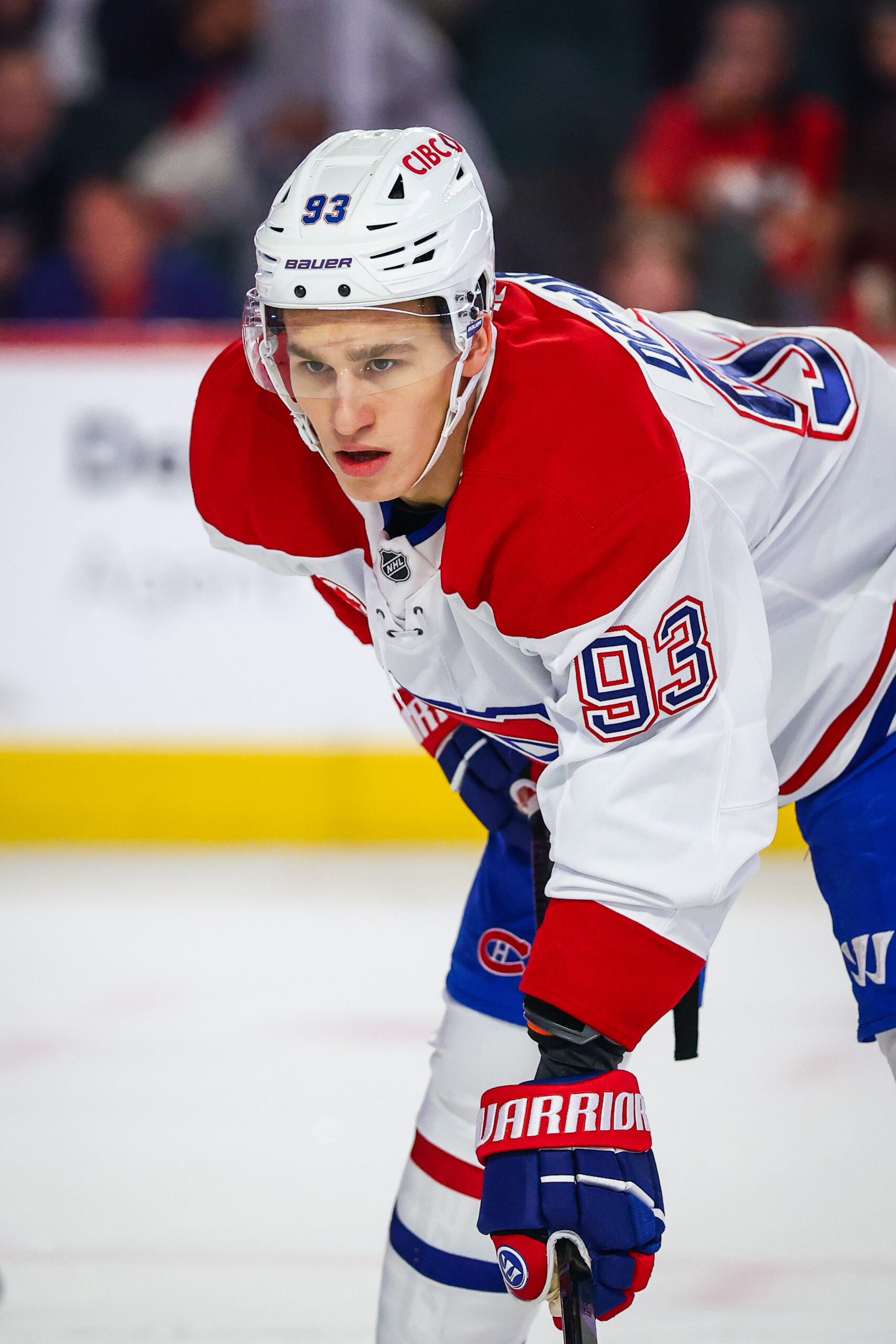 Now, they face another contract discussion of similar magnitude with winger Ivan Demidov. Since the Canadiens burned the first year of his entry-level deal at the end of the 2024-25 campaign (plus their playoff appearance), he’s now set to enter the final season of that pact in 2026-27. That means he’s eligible to sign a contract extension as of July 1st. Both Demidov and management have expressed a willingness to get something done on that front this summer.
But how much would a deal like that cost? The 2024 fifth-overall pick led all rookies in points this past season with 19 goals and 43 assists in 82 games but there’s an expectation on both sides that he has another gear to get to. As is always the case in these types of discussions, those expectations are factored into the price tag, making things a little riskier for both sides. On top of that, the projected bigger increases to the salary cap are making price tags spike. AFP Analytics projects that a seven-year extension for Demidov could check in around $8.3MM per season. It wouldn’t be shocking for Montreal to push for an eighth year which could push the price point more towards the $9MM mark. While they play different positions, would they use Hutson’s new $8.85MM AAV as a ceiling for Demidov?
With Demidov having another full season on his contract, this isn’t a must-accomplish item this summer. But if they want to work out a true max-term eight-year deal, they only have until mid-September to get it done. It took Hutson a few days into the regular season to get his eight-year extension in place last year but if the Canadiens and Demidov want to do the same, they’ll have to work something out a little earlier than that.
Add A Second-Line Forward
For years, there has been a consistent need in Montreal. They have Nick Suzuki anchoring their center group and he’s coming off a 101-point year but they need that second center. It’s not going to be Dach. Alex Newhook seems to fit better on the wing than down the middle. Oliver Kapanen had some success with Demidov during the regular season but when the playoffs came around, he was a regular in the press box with Jake Evans spending a lot of time on the second line. Considering that he’s a checking center, it’s safe to say that need still exists.
The problem, as has been the case for several years now, is that demand for a top-six center greatly outweighs the supply of them. Further adding to that challenge is that there isn’t really a top-six pivot available in free agency. Maybe Claude Giroux would fit on a one-year deal if he doesn’t stay in Ottawa but pickings are slim. Meanwhile, the trade prices for those available are justifiably steep. If one becomes available at a price Montreal is okay with, that would solve the problem. But odds being odds, there’s a better chance it doesn’t happen than it does.
While a second-line winger isn’t as good of a fit as a center, that might be the easier way to upgrade the top six. That winger could fit on the first line and either shift Cole Caufield or Juraj Slafkovsky (who played well with Demidov at times in 2025-26) down, giving Demidov an upgraded linemate while opening up some options for the coaching staff. We’ve seen them linked to Toronto’s Matthew Knies; a move like that is an example of what could work. While that would leave them a little thin down the middle still, having two strong wingers mitigates that somewhat while they hope for Michael Hage to be ready to join the team late next season.
The UFA pool isn’t particularly deep here either but generally speaking, the supply of wingers on the trade market is greater than centers. The acquisition cost will still be steep – especially with the prices being paid in recent days – but an imperfect upgrade is still an upgrade. For now, the backup plan might be more realistic to try to accomplish.
Upgrade The Right Side Again
Two years ago, Montreal moved a younger defenseman in Justin Barron to pick up an upgrade on the right side on the back end, acquiring veteran Alexandre Carrier from Nashville. Then, at the draft last year, they moved two first-round picks and Emil Heineman to the Islanders to pick up Dobson. That’s a lot of work to upgrade that side. It might not be done quite yet.
Those two were the only right-shot defenders on the roster for most of the season, resulting in several different rearguards shifting to their off-side. It was Hutson at times, sometimes Kaiden Guhle, and sometimes depth blueliners Jayden Struble and Arber Xhekaj. Predictably, the results were inconsistent. Hutson fared the best among them but he wasn’t at the level he is on his natural side. Shifting him back to the right shouldn’t be their preferred strategy moving forward.
David Reinbacher, the fifth pick in 2023, has had his development slowed by injuries. While they’re still hopeful that he can be part of the solution relatively soon, at least one more part season in the minors might be best for his development before potentially taking Carrier’s spot (his contract expires next summer) might be ideal.
That creates an opening on either the second or third pairing, one that could be filled short-term or longer-term. They likely would have had interest in Connor Murphy had he made it to the open market as he’d have also filled the box of being someone who could help on the penalty kill. They don’t have to take as big a swing as they did last year but another upgrade on the right side of their defense corps would give them a boost.
Photo courtesy of Sergei Belski-Imagn Images.
Offseason Checklist: Colorado Avalanche
The offseason is now in full effect following Carolina’s Stanley Cup title. Accordingly, it’s now time to examine what teams will need to accomplish over the coming months. Next up is a look at Colorado.
Although many teams in the Western Conference would have been happy with a berth into the Conference Final, this year ended up being nothing but a disappointment for the Avalanche. After being the most dominant team in the regular season, Colorado was outclassed by the Vegas Golden Knights in the Western Conference Final, losing four consecutive games. To add insult to injury, the now-former General Manager, Chris MacFarland, departed for the Avalanche’s division rival, the Nashville Predators, to become their new General Manager and President of Hockey Operations. Now, the reins are back with Joe Sakic to get this team over the hump.
Extend Makar
This one is pretty self-explanatory. Despite having Nathan MacKinnon and Martin Necas up front, there’s little hope for Colorado’s long-term outlook if Cale Makar departs in free agency next summer. A Norris Trophy finalist for the past six seasons, Makar’s six-year, $54MM contract will expire after the 2026-27 campaign.
 It wouldn’t be surprising if he did, but the Avalanche shouldn’t have any expectation that Makar will take a pay cut for his next deal. If he’s seeking the biggest deal possible, his floor will inevitably be Kirill Kaprizov‘s eight-year, $136MM extension signed with the Minnesota Wild. Colorado should plan to have between $17MM and $20MM in cap space next year to ensure it can secure Makar for the long term.
As of now, the Avalanche have a projected $37.75MM available for the 2027-28 offseason, assuming the upper limit of the salary cap reaches $113.5MM. Still, that number is projected after Colorado has made any moves this offseason. Additionally, if Makar signs for $17MM, that leaves approximately $20MM to either retain or acquire 10 additional players.
Although that will leave the team in a bind, it’s difficult to argue that it isn’t worth it. Through the first seven years of his career, Makar has scored 136 goals and 507 points in 470 games, averaging nearly 25 minutes of ice time per game. If he were to keep that production up over a 20-year career, even if he were to maintain his 88% availability due to injuries, Makar would finish only a few points behind Ray Bourque as the highest-scoring defenseman of all time.
Hire A New Powerplay Coach
If the Avalanche were bad at anything this season, it was the powerplay. After struggling last postseason, Colorado had hoped that Dave Hakstol would be the answer, but that didn’t turn out to be the case.
Despite being able to deploy the likes of MacKinnon, Necas, Makar, etc, the Avalanche finished 27th in the league with a man advantage, converting only 17.11% of opportunities. It increased slightly during the postseason, rising to 20.56%, but it didn’t make much difference for them in the end. For what it’s worth, Colorado did finish with a higher powerplay percentage in the playoffs than the Carolina Hurricanes or Vegas Golden Knights.
Obviously, Colorado already has all the talent you could want for two powerplay units, so their biggest change will likely come to the coaching staff to resolve the issue. Especially as they commit to a rebuild, the Avalanche could look to poach David Quinn from the New York Rangers, who managed to have one of the worst teams in the NHL with the fifth-best powerplay.
Additionally, Colorado could target an old friend. Many of the rumblings coming out of Detroit have been about notable players being traded from the Red Wings this offseason. However, assistant coach Alex Tanguay has consistently helped the Red Wings have one of the better power plays in the NHL throughout the last few years, and would be a huge asset to the Avalanche’s coaching staff. Depending on how much the Red Wings tear it down this offseason, Tanguay may welcome an opportunity to win.
Target Defensive Depth
Heading into the offseason, the Avalanche have approximately $7MM in cap space to work with and only four defensemen signed through next season. Inarguably, their top three are set with Makar, Devon Toews, and Sam Malinski. Still, Colorado is set to lose Brent Burns, Brett Kulak, Jack Ahcan, and Nick Blankenburg to the open market next season.
Josh Manson, who is also signed through next season, is a far trickier defenseman to evaluate. He had the second-best offensive season of his career with five goals and 31 points in 79 games. Still, 19 of his points came via secondary assists, meaning he only had a primary impact on 12 points throughout the entire campaign, on the league’s best team. He remains very physical, but may be better-suited as a really good option for the bottom-pairing rather than a mainstay in the top four.
Regardless, given their deployment the past two years, the Avalanche have no qualms about playing either Malinski or Manson on their off-side, giving Colorado plenty of options to pick from. Given their cap situation, the Avalanche could target presumably cheap defensive talent such as Ian Cole or Erik Gudbranson. They can provide low-risk opportunities to former higher-end prospects like Adam Boqvist and Ville Heinola, both of whom are expected to enter the open market soon.
Trade Nichushkin Or Lehkonen
This may be a tougher pill to swallow for an Avalanche fan base that has grown accustomed to elite talent in the top six. Carrying on from the salary cap outlook, incorporating an expensive Makar extension, it’s likely that somebody expensive will have to be moved as a consequence.
Yesterday, Sportsnet’s Elliotte Friedman reported that Colorado was including Valeri Nichushkin, and his $6.125MM salary through the 2029-30 season, in trade talks, with additional flexibility in mind. Given that he’s signed through the next four seasons, the Avalanche could conceivably move Nichushkin for defensive depth, hitting two birds with one stone. He has struggled with injuries over the past few years, but is a big winger who can be a force to play against in the playoffs.
However, if Colorado can’t find a dancing partner for Nichushkin, it may be time to consider moving on from Artturi Lehkonen. Eligible for an extension on July 1st, it’s highly unlikely that the Avalanche will be able to sign both Makar and Lehkonen long-term, even if they move out Nichushkin. If the Avalanche are good at anything, it’s asset management, and trading Lehkonen with one year left on his contract, especially at an exceptionally affordable $4.5MM cap hit, could capture quite the haul.
Since joining the Avalanche in 2021-22, Lehkonen has been around a 50-point producer when healthy. However, his draw comes from the postseason, where he has scored 23 goals and 41 points in 56 games since putting on the burgundy. Like Nichushkin, Lehkonen only has a 12-team no-trade list in his contract, giving Colorado plenty of options. If they consider moving him, there’s a chance the Avalanche could improve their defensive depth and prospect capital in the same trade.
Photo courtesy of Jerome Miron of Imagn Images.
Offseason Checklist: Buffalo Sabres
The offseason is now in full effect following Carolina’s Stanley Cup title. Accordingly, it’s now time to examine what teams will need to accomplish over the coming months. Next up is a look at Buffalo.
For the first time in 15 years, the Buffalo Sabres made the postseason. They didn’t just squeak in, either. Buffalo won the Atlantic Division after finishing the regular season with 109 points, defeated the Boston Bruins in Round One, and took the Montreal Canadiens to the limit in Round Two. There’s no question that the 2025-26 campaign was a major step forward for the organization, but there’s still work to be done to turn this team into a legitimate Stanley Cup threat.
Replace Tuch
Although things could change, there’s a growing expectation that Alex Tuch will depart the Sabres this offseason. As much as Buffalo would like to keep him, it appears that Tuch’s contract demands are too rich for General Manager Jarmo Kekalainen. Earlier in the year, it was reported that Tuch was seeking an eight-year, $85MM extension ($10.625MM AAV), the same that Adrian Kempe signed with the Los Angeles Kings.
Since then, Tuch’s contract demands have increased, and his AAV may exceed $11MM on the open market due to a remarkably thin free agent market and a rising salary cap limit. The Sabres may be making a prudent move by letting him walk rather than sign him to that price point, but they will still need to find someone who can match his value to plug into their top six.
Throughout the past four years, despite missing the playoffs for most of those campaigns, Tuch has remained a consistent contributor. Since the beginning of the 2022-23 season, Tuch has scored 127 goals and 271 points in 310 games with a +63 rating, averaging 19:13 of ice time per game. Essentially, Buffalo will be on the hunt for a 30-goal scorer.
Fortunately, that should be relatively easy to address. Although he doesn’t have the same track record, the Sabres could easily sign Anthony Mantha in a few days. He’s not a lock for 30+ goals, but he’s coming off a solid season and will be far cheaper than Tuch. Additionally, Buffalo could look to an Atlantic Division rival for help. It’s already well known that Dylan Larkin has requested a trade from the Detroit Red Wings, but the Sabres could also try to poach Alex DeBrincat from them instead, depending on how they navigate the offseason.
Make A Decision On Byram
Nearly since they acquired him from the Colorado Avalanche at the 2023-24 deadline, Bowen Byram has been in trade chatter. Now, it feels like the trade speculation has reached a fever pitch because Byram is only one year away from reaching unrestricted free agency.
 Furthermore, his agent, Darren Ferris, generally advises his clients to pursue free agency. Inevitably, even if Buffalo manages to sign him to a long-term extension, the negotiations won’t be easy, nor favorable. Instead of turning into a Tuch situation, where Byram would leave for nothing, it may be prudent to move him this summer and take advantage of a fluid trade market.
There shouldn’t be any shortage of suitors, either. Unlike most of the prominent names on the trade block this summer, Byram doesn’t have any trade protection in his contract, giving the Sabres the pick of the litter. He’s been a rock-solid defenseman for Buffalo, scoring 18 goals and 80 points in 164 games over the past two years while averaging 22:31 of ice time per game. He would immediately fill any team’s need for a top-four defenseman.
Still, it’s important to note that other teams are aware of his situation. As much value as he has, it’s hard to imagine a team paying a hefty price for Byram if he’s going to leave next summer, anyway. For the best return, Buffalo should allow Byram and his representation to negotiate an extension with the acquiring team. If he’s unwilling to and wants to consider his options in free agency, that would make the situation much more complicated from Buffalo’s perspective.
Trade A Goalie (Or Two)
Although the Sabres could go in either direction for Byram, they’ll most certainly need to trade a netminder this offseason. Given the performances of Ukko-Pekka Luukkonen and Alex Lyon this season, Colten Ellis is objectively the odd man out in Buffalo. Ellis was solid in a third-string role, managing an 8-4-2 record in 16 games with a .903 SV% and 2.90 GAA.
The decision to move him stems from Kekalainen’s roster construction ideas, not his performance. One of the first things Kekalainen said at his introductory press conference was that he didn’t want Buffalo to carry three goaltenders on the roster long-term. Because of some mild injury concerns, the Sabres didn’t need to make that call toward the end of the 2025-26 campaign, but they’ll now have all summer to do so. If he’s adamant on carrying only two goaltenders, they’ll either have to trade Ellis this offseason or risk losing him on the waiver wire in October.
Additionally, the Sabres will likely need to trade Devon Levi during the offseason as well. In mid-May, Jeff Marek of the Daily Faceoff shared that the relationship between Levi and the Sabres organization is “over” and that Buffalo will explore moving him this offseason.
A standout goalie at the NCAA level, Levi has shown flashes of dominance with the AHL’s Rochester Americans, managing a 64-39-22 record in 120 games with a .914 SV% and 2.52 GAA over the past four years. There’s little argument that Levi has earned a starter role in the NHL, but he has earned the opportunity to play in a backup role, or even a 1B role, at the very least.
Improve Faceoff Percentage
It’s not high on the priority list, but the Sabres could really use a center that can consistently win faceoffs. Buffalo finished as the worst Eastern Conference team in the faceoff dot last season, averaging a 46.73% success rate on draws.
On the free agent market, depending on his asking price, the Sabres could target Scott Laughton. Between the Toronto Maple Leafs and the Los Angeles Kings, Laughton won 57.7% of faceoffs. Still, that’s the highest mark he’s ever averaged over an entire regular season, and he only averaged 49.7% throughout his time with the Philadelphia Flyers.
However, Buffalo could take advantage of a cap-strapped Colorado Avalanche. There’s a growing concern out of Denver that Jack Drury, despite being a restricted free agent, could have priced himself out of the Avalanche’s long-term plans. Unlike Laughton, Drury has been an efficient faceoff taker throughout his entire career, averaging a 57.1% success rate over 2,500 draws.
Photo courtesy of Timothy T. Ludwig of Imagn Images.
Offseason Checklist: Anaheim Ducks
The offseason is now in full effect following Carolina’s Stanley Cup title. Accordingly, it’s now time to examine what teams will need to accomplish over the coming months. Next up is a look at Anaheim.
After missing the playoffs last season for the seventh straight season, Ducks GM made a big change behind the bench, bringing in Joel Quenneville to try to help push his young core group to another level. That’s exactly what happened as Anaheim made it to the second round before being eliminated by Vegas. Now, Verbeek has some work to do this summer to help keep his team in a spot to try to get back to that level in 2026-27.
Reshape The Defense
The Ducks finished off the season with a very deep defense corps and a strong mix of youth and veterans. Fast forward to today and there are a boatload of question marks to be addressed.
On the veteran side, John Carlson was a strong addition at the trade deadline but he’s set to test unrestricted free agency and doesn’t appear intent on returning. Jacob Trouba is also UFA-eligible, as is captain Radko Gudas. Those are three of their top-four right-shot defensemen. At a minimum, they need to re-sign or replace one, if not two of those. Drew Helleson gives them a bit of lower-end depth but that’s hardly enough to work with. Ian Moore could move back to defense after spending a lot of time up front but again, he’s only a depth option. Tristan Luneau and Noah Warren aren’t ready for full-time duty yet either, so retaining or replacing two top-four options would be ideal.
Things are a bit more stabilized on the left with Jackson LaCombe locked up long-term. But he’s the only one under contract, as Olen Zellweger and Pavel Mintyukov are pending restricted free agents. And with neither of them really establishing themselves as a full-time top-four defender, both have been part of trade speculation over the past year or so. Both could be retained but there’s a case to make to keep one and move one, then bring a different type of defender in to fill the third spot.
It’s not too often that a playoff team could overhaul half of its back end. Depending on what happens over the next few weeks, it could happen to Anaheim so Verbeek is going to need to be aggressive to try to keep some of his players and be active on the trade front and in free agency to fill out the rest of his group.
Re-Sign Core RFAs
There have been some difficult contract talks in recent years between Verbeek and several of his core youngsters. With the team holding more leverage coming off an entry-level deal, the team has used that to their advantage to avoid setting big precedents. It’s not that they won’t sign a player long-term coming off their rookie contract – they did just last year – but it’s not a given like it is for many other teams. Two more potentially difficult contract talks loom as center Leo Carlsson and winger Cutter Gauthier will have their first contracts end at the end of the month.
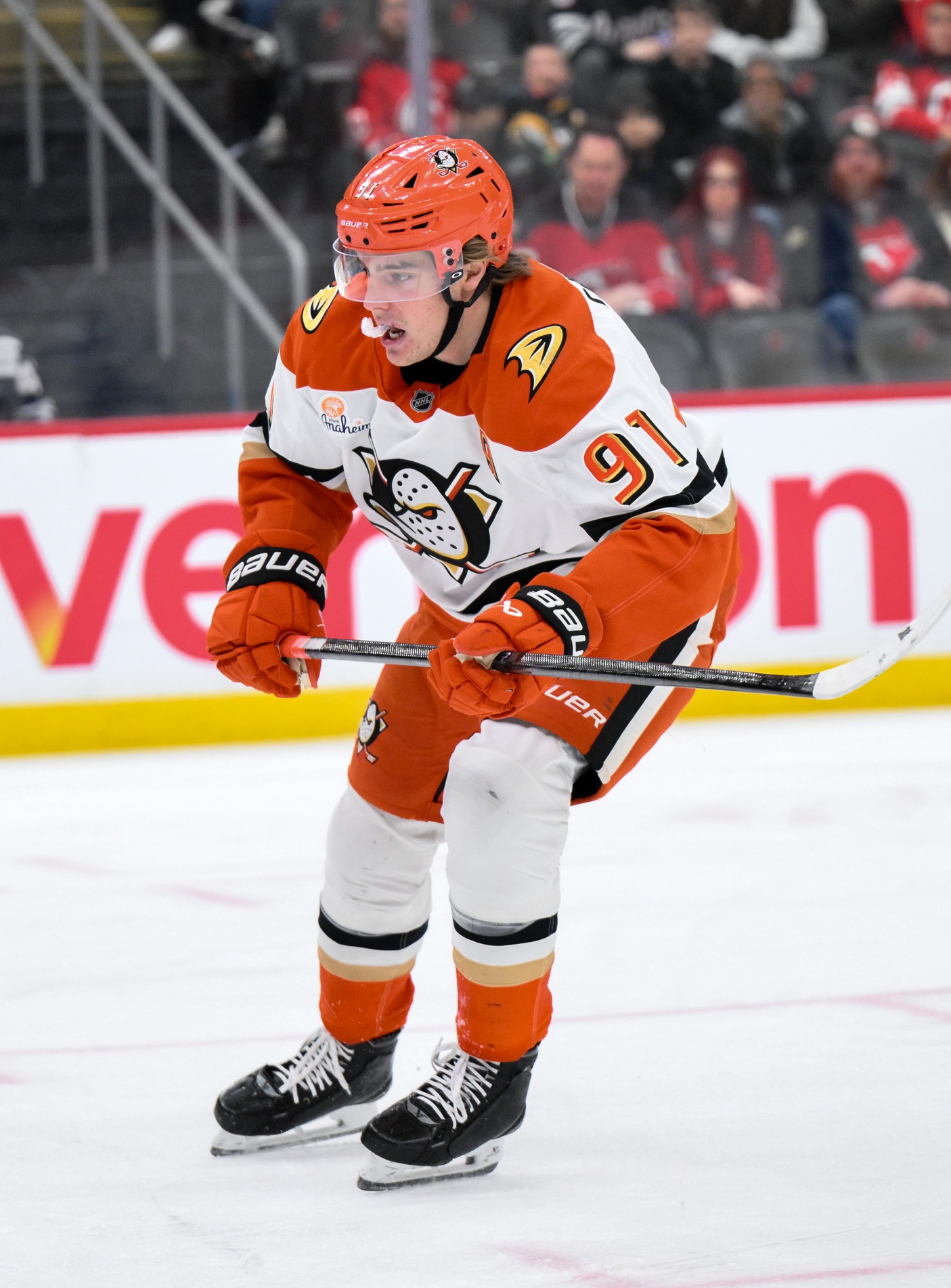 Carlsson took a big step forward toward reaching his potential this season. After putting up 20 goals and 25 assists in his sophomore year, the 2023 second-overall pick finished second on the Ducks in scoring this season, tallying 29 goals and 38 helpers in 70 games. He upped his faceoff percentage by three percent as well; while it was still fairly low, it was ten percent better than his rookie year which is a step in the right direction. The big breakout hasn’t necessarily come yet but Carlsson appears to be on his way.
His camp will be looking to get paid with that in mind. The price tag for young impact centers keeps going up with Logan Cooley (eight years, $80MM) being the recent standard for comparison. While Verbeek has been able to keep $7MM as the high standard for forwards, that’s going to change as realistically, even a short-term bridge deal could surpass that. Meanwhile, AFP Analytics pegs a max-term eight-year contract at around $11.4MM per season. As a quick comparison, Cooley has 152 points in 211 NHL regular season games as he starts his second deal. Carlsson is at 141 in 201. The double-digit AAV range is where Verbeek will need to go to get a long-term deal done with his top pivot.
As for Gauthier, his sophomore season was also a big improvement on 2024-25. He led Anaheim in scoring, tallying 41 goals and 28 assists in 76 games, a jump from the 20 goals and 24 assists the year before. He appears to be well on his way to becoming the scoring winger that Philadelphia thought they were getting when they drafted him fifth overall. Of course, when he wouldn’t sign with them, he was moved to the Ducks for a package that included Jamie Drysdale, one of the recent post-entry-level negotiations that felt a little contentious at the time.
It’s worth noting that, unlike Carlsson, Gauthier isn’t eligible to sign an offer sheet since he only played in one game in his first season. That gives Verbeek a bit more leverage in talks with there being no potential outside threat. Accordingly, the projections are a bit lower; AFP Analytics has a seven-year contract checking in a little over $8.8MM per season while a three-year bridge could check in around $6.3MM.
Cap space isn’t going to be a factor here. The Ducks have over $38MM at their disposal, per PuckPedia, which is more than enough to re-sign both core youngsters, reshape the defense, and have plenty left over. But it wouldn’t be shocking if history repeats itself and these two contracts take a while.
Examine McTavish Options
McTavish was one of the other trickier contract negotiations in recent years but he was one of the exceptions in that he received a longer-term contract, a six-year, $42MM pact. The $7MM AAV tied him for the team lead (at the time, LaCombe has since passed it) and the thought was that one of Anaheim’s core pieces was locked up for the long haul.
One year later, his status isn’t as certain. Yes, McTavish is still locked up for five more years but his status as a core piece is now in question. This season, he played in 75 games, notching 17 goals and 24 assists. It was his fourth straight season surpassing 40 points but he also saw his production dip from 52 in 2024-25 in a year where Anaheim’s offensive output as a team increased considerably. Then, in the playoffs, he wound up being healthy scratched a couple of times.
McTavish is still just 23 years old and is a natural center, elements that should be particularly appealing to other teams. Given Anaheim’s center depth, McTavish saw a bit of time on the wing this year which isn’t as ideal from a trade perspective. While he’s coming off a down year, the demand for quality pivots is high enough that they could still land a strong return. Is that the right approach to take or should they hold onto him for another season? Verbeek needs to investigate what’s out there offer-wise to make that decision.
Backup Goalie Upgrade
Some eyebrows were raised when Verbeek decided to sign Ville Husso to a two-year, $4.4MM contract to essentially serve as the third-string option behind Lukas Dostal and Petr Mrazek. With Mrazek ultimately dealing with injuries and undergoing hip surgery (limiting him to 10 games), Husso wound up being the second-string option for most of the season.
But the results weren’t great. The 31-year-old made 19 starts but posted a 3.25 GAA and a .884 SV%, numbers that were well below league average. This is something that can certainly be upgraded on and with Dostal struggling with his biggest workload (his SV% was only .888), getting a more reliable option here becomes that much more important.
In terms of finding a reliable backup who could cover 30-35 starts, the UFA market isn’t the deepest. Stuart Skinner can shoulder that workload but he has run hot and cold over the last few years. Connor Ingram had a decent season and might have some upside but he might be looking to go somewhere with a shot at a bigger workload than what the Ducks have to offer. Frederik Andersen and Cam Talbot have been those types of goalies in the past but are getting up there in age.
Speculatively, Boston’s Joonas Korpisalo feels like a good fit here. He has been a starter before and can handle the workload the Ducks would need him too. His numbers haven’t been great but were better than what Anaheim’s netminders put up this past season. At $3MM, he wouldn’t cost much more than Husso (who would probably go back to the third-string role) while the Bruins could benefit from the cap relief and might want to give Michael DiPietro a shot at the full-time backup role.
Whether it’s a free agent, Korpisalo, or someone else altogether, getting more of a stabilizing presence at the backup goalie spot is a good way to try to get a few extra points in the standings and take some pressure off Dostal in the process.
Photo courtesy of John Jones-Imagn Images.
Offseason Checklist: Minnesota Wild
The offseason is now in full effect following Carolina’s Stanley Cup title. Accordingly, it’s now time to examine what teams will need to accomplish over the coming months. Next up is a look at Minnesota.
The Wild’s front office preached patience for years while navigating the dead cap obstacles provided by Zach Parise‘s and Ryan Suter‘s buyouts. Now, those restrictions are almost entirely in the rearview with a sharply increasing salary cap upper limit to boot. Their newfound sense of freedom allowed general manager Bill Guerin to make two of the most consequential moves in recent memory over the course of last season, handing out Kirill Kaprizov‘s record-breaking eight-year, $136MM extension and pulling off the Quinn Hughes blockbuster acquisition. While his work helped the Wild reach the second round for the first time in more than a decade, they were quickly stamped out by the Avalanche when they got there and still don’t stand above the rest as a true Stanley Cup favorite in the NHL’s most top-heavy division. Doing so with a new megadeal kicking in will be Guerin’s make-or-break.
Lock Hughes In
The best gift the Wild can give themselves this summer is cost certainty, whether it’s restrictive or not. The new cornerstone of their defense – that cost them the equivalent of four first-round picks to acquire – is entering the final year of his contract at a now-bargain $7.85MM cap hit and becomes eligible to sign an extension in 11 days.
No one is expecting that news to drop on July 1. There has long been well-founded speculation that Hughes would love to, at some point in his career, link up with New Jersey-based brothers Jack Hughes and Luke Hughes, whether that’s with the Devils or elsewhere.
That’s not to say he isn’t interested in extending his stay in the State of Hockey. He made it clear after the Wild’s season ended last month that he was open to extension discussions this summer.
A max-term deal to keep him committed to Minnesota for his whole prime seems unlikely for reasons mentioned above. The Athletic’s Michael Russo reported that the Wild tried to acquire Luke to join him this season but were unsuccessful. With that very real storyline in mind, most are expecting a three-year extension to align the expiry of Quinn’s next deal with Jack’s current one, allowing those two to pick their next destination together in 2030.
Of course, that would be a rare choice for a player in his position, but the desire to play with his brothers is an extenuating circumstance. AFP Analytics’ extension projection is an eight-year term at just north of $15MM per season. That cap hit likely wouldn’t change much on a shorter-term deal to make him the league’s new highest-paid defenseman by a wide margin. It would also leave the Wild with around $30MM in projected cap space for 2027-28 with half their roster unaccounted for. That’s worth monitoring.
Find A Top-Six Center
Acquiring Hughes came at the expense of thinning out Minnesota’s already fragile center depth, just as Marco Rossi was beginning to hit his stride. With Rossi out of the picture, there’s no clear-cut top-six option outside of two-way standout Joel Eriksson Ek who’s better cast as a high-end second-liner.
Danila Yurov, a late first-round selection in 2022, could be an option long-term after seeing some significant time down the middle last year. But he’s a natural winger and only managed 12 goals and 27 points as a rookie, not the type of production worthy of earning a look down the middle next to Kaprizov.
 Minnesota’s large existing financial commitment to Kaprizov and their pending one to Hughes, plus the assets they already gave up to acquire him, likely take them out of the picture for any truly marquee No. 1 piece – not that there are even any available at the moment. A lower-end first-line option, though, like the Red Wings’ Dylan Larkin, is feasible.
He’s coming off a fifth straight 30-goal, 60-point season and won’t be back in Detroit next season after requesting a trade. Helene St. James of the Detroit Free Press believes the Wild are one of three teams on the initial list of clubs for which he’s willing to waive his no-move clause, so that’s one obstacle out of the way.
Rebuild Wing Depth
Aside from their center question, this offseason will still see notable change to Minnesota’s forward group. They have several veterans hitting the free agent market, particularly on the wings.
One of them, recent second-line mainstay Marcus Johansson, has already opted to return to his native Sweden and won’t be back. Also hitting the open market are Mats Zuccarello, Vladimir Tarasenko, and trade-deadline pickup Nick Foligno.
Tarasenko is the youngest of that group at age 34. It’s fair to question whether any of them should be brought back. With that bit of organizational depth needing replenishing, it’s fair to wonder if Guerin will target several younger names on the open market – potentially some non-tendered RFAs in need of a fresh start – to fill those support slots up and down the forward lineup.
Improve Possession Play
The Wild’s strong special teams on both ends were a big reason behind their 104-point record. Their 5-on-5 possession numbers – which the past several Stanley Cup champions have now shown are usually a great marker of postseason success – were uncharacteristically poor.
Minnesota’s defense-oriented identity through most of their franchise history has usually served them well in that regard. Yet they only controlled 48.8% of shot attempts at 5-on-5 last year, 24th in the league and their second straight year under the 50% mark.
The Wild will need to decide whether their possession struggles, coinciding with head coach John Hynes’ hire in late 2023, are a coincidence or not. After back-to-back playoff appearances, they’re not overly eager to make a coaching change.
Analytics-forward front offices such as Florida’s and Carolina’s are fast becoming the mark of consistent championship contenders. It’ll be up to Guerin now whether he decides to follow that increasingly proven path.
Image courtesy of Charles LeClaire-Imagn Images.
Offseason Checklist: Philadelphia Flyers
The offseason is now in full effect following Carolina’s Stanley Cup title. Accordingly, it’s now time to examine what teams will need to accomplish over the coming months. Next up is a look at Philadelphia.
Expectations weren’t particularly high for the Flyers heading into the season. Even with Rick Tocchet taking over behind the bench, the thought was that this would be another transition year as they work through their rebuild. However, things went quite well in 2025-26, especially in the back half of the year, resulting in a playoff spot and a first-round victory over Pittsburgh before being swept by Carolina. Now, GM Daniel Briere has some work to do to reshape his roster (he has already made one move of note) to give them the best chance of getting back to the postseason next year.
Look Into Ristolainen Options
For the last two years, there has been plenty of speculation that the Flyers could look to move defenseman Rasmus Ristolainen. Briere has listened to offers but put too high of a price tag on Ristolainen’s services so the veteran remains with Philadelphia and logged big minutes in the playoffs.
Now, he’s set to enter the final year of his contract, one that pays $5.1MM. There was a time when it looked like that deal was well above market value but now, it almost feels like a small bargain. Ristolainen is back to logging over 20 minutes a night with a willingness to get into the shooting lanes to block shots. At 31, he’s still young enough to command another multi-year deal; AFP Analytics suggests a four-year contract worth a little over $6MM could make sense. In this market, that feels like a reasonable move for the Flyers to make which would presumably take him out of that trade speculation.
On the other hand, there is an expectation that the trade market will be more robust this year so maybe now is the time to get a trade done. The acquiring team would get a full year out of Ristolainen while if they need to move money to make room, it’s generally easier to do so now than this time a month from now, for example, or in-season. Making a move now could open up a spot for the Flyers to look for a replacement in free agency if one didn’t come back as part of the trade package.
This isn’t a decision they necessarily have to make over the next week or two. But there are some options for Briere to investigate that could help shape their planning so if he hasn’t been doing so already, it will be time for him to start.
New Deals For Key RFAs
The Flyers have made a pair of notable moves with Anaheim in recent years, bringing in a pair of core players in defenseman Jamie Drysdale and forward Trevor Zegras. Their bridge contracts – ones that took a long time to get done when they were still with the Ducks – are now expiring, leaving them both as restricted free agents with arbitration rights this summer. With over $32MM in cap space per PuckPedia, all options will be available to the team in these discussions.
 Drysdale has the longer tenure with Philadelphia, having been acquired back in early 2024 as part of the return for Cutter Gauthier, who made it clear he had no intention of signing with the Flyers. While his first impression wasn’t great, he has turned things around since then. Specifically, he was largely healthy this season, something that hasn’t been the case too frequently over his six-year career. Drysdale chipped in with 32 points while logging 21:33 per game, a career-high in ATOI. Is that enough for the Flyers to commit long-term? If so, AFP Analytics’ projection is a six-year pact worth a little under $7.3MM per season. He’s shown that he can be a legitimate top-four defender and this contract would certainly pay him like one.
As for Zegras, the change of scenery last summer worked probably better than the Flyers would have hoped for. He didn’t just rebound after a rough 2024-25 year; instead, he put up a career year offensively, one that saw him produce 26 goals and 41 assists in 81 games to finish one point behind Travis Konecny for the team lead. That flipped in the playoffs with Zegras leading the way, one point ahead of Konecny. While playing down the middle didn’t exactly work, the 25-year-old made things work on the wing and now it looks like he has a chance to be a fixture for a while. AFP Analytics pegs a five-year deal surpassing the $8MM mark in AAV which would be a multi-million-dollar jump from his expiring contract.
The challenge here is if the Flyers aren’t ready to commit these types of pricey deals or the two sides are too far apart. Both Drysdale and Zegras are two years away from UFA eligibility. If talks don’t go well and Philadelphia files for arbitration, both players could (and likely would) elect two-year awards to take them to the open market, giving them a bigger hammer in negotiations. So, Briere’s options might be a one-year second bridge contract or the long-term pact. They have a lot to work through over the next couple of weeks with these two.
Search For An Impactful Offensive Center
Last offseason, Briere certainly attempted to address the center position. He brought Zegras in, who was a natural middleman but again, that didn’t go so well in Philadelphia. Meanwhile, he brought Christian Dvorak over in free agency, signing him to a one-year deal that looked like an overpayment at the time. He wound up having a career year himself, picking up 51 points while signing a new five-year deal that was only slightly cheaper than the $5.4MM he made this season. Both moves worked out rather well for the Flyers.
However, the need for an impactful offensive middleman still remains. Zegras might be a top-liner for them long-term but it will probably be on the wing. Dvorak did about as well as expected in a top-line role but that’s not the best fit for him in the long run. After being a third-liner for most of his career, he’s probably not going to be the offensive anchor either. Meanwhile, Noah Cates is more of a secondary producer while Sean Couturier’s best days are behind him at this stage of his career.
The Flyers have amassed a decent prospect pool of centers as well. Jett Luchanko has already had a couple of brief NHL looks while Jack Nesbitt and Cole Knuble have some upside as well. But, again, none of them really profile as legitimate number one options either.
As has been well-documented, there isn’t exactly a surplus of established high-end centers out there on the trade market while there aren’t any in unrestricted free agency. But we saw the impact of raising the ceiling at that position last summer, even with Zegras landing on the wing. Doing that again will be easier said than done but it would certainly give them a significant boost heading into next season.
Find Power Play Help
32nd, 30th, 32nd, 32nd, and 32nd. This is where the Flyers ranked in terms of power play percentage over the last five seasons. Cumulatively over that span, you can probably guess where they rank as well. This isn’t just a short-term sort spot but rather a long-term problem. Over that time, most of the roster has turned over but it hasn’t gotten any better.
On the back end, none of their blueliners are necessarily prototypical quarterbacks with the man advantage. Drysdale, Cameron York, and Travis Sanheim all have some offensive skill but haven’t been able to succeed with any sort of consistency. Whether it’s shopping at the top end of the free agent market or looking for someone who fits a little lower on the depth chart but could anchor a power play unit, that would certainly help.
Up front, obviously, a top center would move the needle. Zegras showed some promise with the man advantage this season and they’ll be hoping that Matvei Michkov can take a step forward. So there’s a bit of cause for optimism for some internal improvement, at least. But they need to find a way to get more out of players like Owen Tippett (seven power play points) and even Konecny (14). An extra creative player or a true shooting threat could open up some options.
Making the playoffs in spite of having the worst power play in the NHL is pretty good. But counting on a repeat with those struggles would be asking a lot. Accordingly, shaking up the power play personnel to try to give those units a lift could certainly pay some dividends.
Photo courtesy of Hannah Foslien-Imagn Images
Offseason Checklist: Tampa Bay Lightning
The offseason is now in full effect following Carolina’s Stanley Cup title. Accordingly, it’s now time to examine what teams will need to accomplish over the coming months. Next up is a look at Tampa Bay.
While the Lightning lost the Atlantic Division lead down the stretch, they were still considered one of the favorites to come out of the East in the playoffs following a solid regular season. Instead, they were ousted by Montreal in the opening round, the fourth straight year that they’ve suffered that fate. However, GM Julien BriseBois has a bit more cap and roster flexibility than he has had in recent years, giving him a chance to make some changes to his roster this summer. Here’s what’s likely to be on Tampa Bay’s to-do list.
Replace Raddysh
With Victor Hedman not being available for the bulk of the season, they were hoping that Darren Raddysh would be able to pick up the slack. It’s fair to say he did that and much more, exceeding all expectations. He didn’t just become the top-scoring defenseman on his team; he became one of the top-scoring defensemen in the NHL, earning him some down-ballot Norris Trophy consideration. After putting up 70 points over the two previous seasons combined (his first two NHL campaigns), he managed that many this season alone, putting him seventh league-wide in that department while his 22 goals were tied for third-most.
And what a time it was for his breakout. For starters, he was instrumental in keeping the Lightning in the race for the division title during the regular season while logging big minutes in the playoffs. But from a personal perspective, the timing couldn’t have been better with his $975K per season contract coming to an end next month.
You all know what happened next, as Toronto swung a trade to acquire Raddysh along with a front-loaded salary on an eight-year, $68MM contract. They were prepared to pay Raddysh’s asking price while BriseBois, despite having the cap space to do so ($13.17MM per PuckPedia), elected not to. It’s a defensible approach to take considering the only one elite year but it’s fair to say that his absence now is a big blow to their back end.
With re-signing Raddysh no longer being an option, BriseBois needs to swing big to find a replacement. The rest of the right side of their depth chart on the back end is Erik Cernak and Maxwell Crozier, players who aren’t capable of logging the big minutes Raddysh did this season. John Carlson and Rasmus Andersson are the next-best right-shot blueliners available in free agency and it’s fair to say that the Lightning will be taking a big run if they’re not signed beforehand. This will take up well over half of their cap space but they need another high-impact right-shot defender in the mix in training camp.
Work On Kucherov Extension
Nikita Kucherov has been one of the top-scoring forwards in the NHL for the better part of the last decade. While he didn’t lead the league in scoring in 2025-26 (snapping that streak at two), he finished second and won the Hart Trophy which is still quite elite. His current contract, one that carries a $9.5MM AAV, has certainly aged more than well for the Lightning, becoming one of their more team-friendly contracts despite it being their richest one (tied with Andrei Vasilevskiy). That contract is set to expire next summer, meaning that Kucherov will be eligible to sign a contract extension on July 1st.
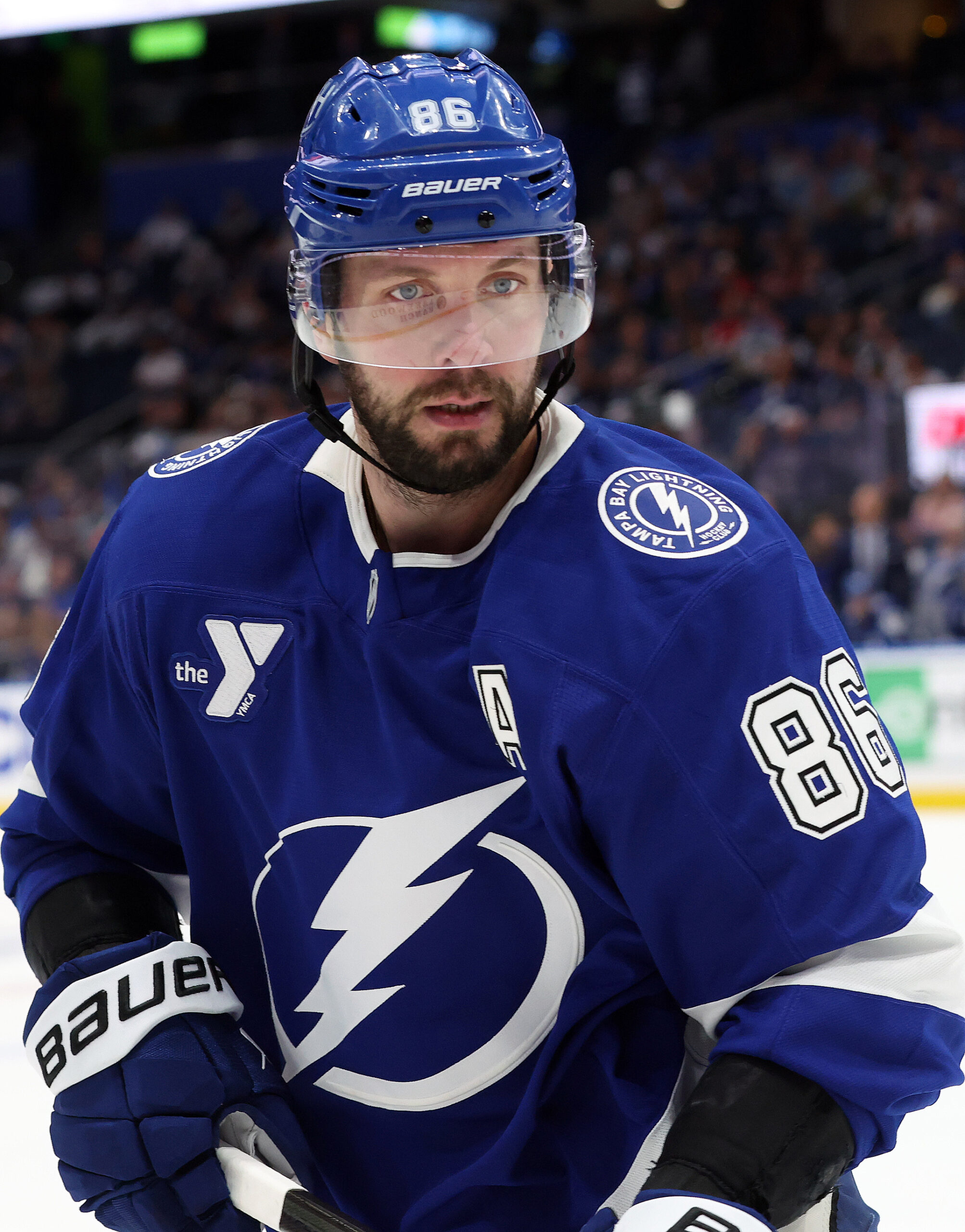 Kucherov will be 34 when that next contract begins, meaning that he should still have a couple of elite seasons in the tank before starting to slow down some. But even slowing down, there’s a case to make that he’ll have some top-line years (or at worse top-six) ahead of him for a few more years. Add to that the big jumps coming to the salary cap and there’s a chance that there could be a bit of sticker shock on his next contract.
AFP Analytics projects that a two-year extension for Kucherov could see his price tag increase to a little over $12MM per season. Speculatively, at that point, the decline would be starting and a subsequent deal could check in at a more affordable rate. Alternatively, Tampa Bay could look to lock him up on another longer-term agreement (five or six years, for example) and use some of those expected decline seasons to lower the AAV, potentially closer to where it is now. There’s also the possibility that Kucherov leaves a bit of money on the table as several veterans have over the years although that’s not necessarily something that BriseBois can bank on happening.
Since Kucherov is signed through next season already, this isn’t something that necessarily has to be at the top of the to-do list this summer. (That said, the team has signed a lot of early extensions at the beginning of free agency before.) Even if they don’t get something finalized, merely having some talks to get a feel for what the cost might be would be beneficial for planning purposes.
Look Into Backup Upgrades
For several years now, the Lightning have needed to go with low-cost second-string backup goaltenders. Vasilevskiy being one of the top-paid goalies in the league played a role in that as did their limited cap room. But with a bit more flexibility this summer, this is something they could look to pursue.
Jonas Johansson has been the backup for the last three seasons, posting a 3.28 GAA and a .889 SV% over that stretch; his 2025-26 numbers were a little worse than those averages. That the team still won 11 of his 23 starts is a positive sign with a below-average option in goal but imagine what even a small upgrade could do. If a replacement could win even two or three more of those, that’s a big bump in the standings, especially in a very tight division that could get even tighter next season. It’s low-hanging fruit but an upgrade could prove rather fruitful.
BriseBois wouldn’t need to shop in the upper tier of the UFA market. But veterans like Cam Talbot, Vitek Vanecek, or David Rittich shouldn’t cost considerably more than Johansson’s $1.25MM AAV (all but $25K of which would come off the books if he was waived and sent to AHL Syracuse). While that would cut into what they have left to spend on their other needs, the potential payoff in the standings would make it money well-spent.
Add Right-Shot Forwards
With Corey Perry and Oliver Bjorkstrand set to hit the open market next month and Scott Sabourin not being an every-game player, Tampa Bay’s list of right-shot forwards is rather small. It starts with Brayden Point but that’s also where the list ends. Yes, as their roster stands now, they have one right-shot forward in their top 12.
Needless to say, this is something that needs to be rectified. Having too many players shoot on the same side takes away some options, particularly on the power play. And having options limited is hardly ideal.
A second top-six forward to balance out the first two forward lines – the role that Bjorkstrand was originally hoped to fill – would be the bare minimum to try to fill here. That player would also play a role on the second power play unit, alleviating some of the concerns about too many left-shot shots there as well. Then, bringing in a couple of right-shot depth pieces could open up some options in the bottom six as well.
Of course, this is all easier said than done given their cap constraints. For them to go this deep into addressing this need, some additional cap space will need to be opened up or they’ll have to use some very cheap players. One of those to keep an eye on is Sam O’Reilly. The Memorial Cup MVP had a very strong final season in the OHL and could be a candidate to make the jump to the NHL right away. It doesn’t always work out as planned – Conor Geekie is an example of that – but O’Reilly could make an immediate impact lower in the lineup to help give them some balance and skill in the bottom six.
With the other areas of need, it seems unlikely that BriseBois will be able to make a bunch of moves to balance out the handedness up front. But it’s fair to say that some work will need to be done on that front over the next few months.
Photo courtesy of Kim Klement Neitzel-Imagn Images.
Offseason Checklist: Utah Mammoth
The offseason is now in full effect following Carolina’s Stanley Cup title. Accordingly, it’s now time to examine what teams will need to accomplish over the coming months. Next up is a look at Utah.
As the Mammoth’s long-term rebuild continues to work toward its conclusion, the expectation this season was that they’d be able to get to the postseason. With a younger group progressing while being augmented by some offseason movement, that was a logical goal and one they achieved before being ousted in the opening round by Vegas. With things on track in their rebuild, their offseason to-do list revolves more around roster tinkering than another summer of significant shakeups.
Sign A Backup Goalie
With the organization deciding quickly to move on from Connor Ingram, they wasted little time last summer signing a replacement by inking Vitek Vanecek to a one-year, $1.5MM contract. The overall results weren’t great, with a GAA and SV% below league average while he won just five of his 19 starts. That resulted in Karel Vejmelka being leaned on heavily – too heavily – as he led the league in games played in minutes.
With Vanecek set to become an unrestricted free agent again, the backup goalie slot is open once again. Their internal options either aren’t ready for the NHL yet (Michael Hrabal) or are depth options (Jaxson Stauber) so the solution isn’t coming from AHL Tucson. They could simply opt to bring back Vanecek but given that this is a position that can be upgraded on and a likely desire to not play Vejmelka as much, it seems likely they’ll look elsewhere to fill the spot.
The UFA class isn’t overly deep this summer. As things stand, Ingram is arguably one of the better backups out there but the door is likely closed on that front. Stuart Skinner has been a streaky goalie in his career but can play a bigger workload to take some pressure off Vejmelka. David Rittich, Frederik Andersen, and Cam Talbot are all players who could cover 25-30 starts next season as well.
If those options aren’t appealing, the trade market could be an option. Buffalo is facing a bit of a crunch with now four waiver-eligible netminders, making one a likely trade candidate. Others will likely become available depending on how free agency goes in a couple of weeks.
There are enough options that GM Bill Armstrong shouldn’t have to pay a hefty price to land a second-string goalie, either in the form of a UFA contract or an acquisition cost. But it’s one spot that they will need to fill over the next few weeks.
Make A Decision On Hayton
When Phoenix drafted Barrett Hayton fifth overall back in 2018, it was viewed as somewhat of a reach. The Coyotes needed a center and with one already off the board (Jesperi Kotkaniemi), he was the next-best one available in their view so they took him. Since then, over parts of seven NHL seasons, the 26-year-old has shown flashes of legitimate top-six upside mixed in among multiple rough patches.
 Now, Hayton finds himself a restricted free agent this summer. He’s eligible for salary arbitration and is only one year away from reaching unrestricted status. With how up and down things have been so far in his career, both sides have a decision to make. Does Utah want to make another multi-year commitment to a player whose spot on the depth chart has dropped a bit? For that matter, does Hayton want to make a multi-year commitment knowing how the free agent market is for centers?
In 2024-25, Hayton looked like he might have turned the corner, setting new career highs offensively with 20 goals and 26 assists in 82 games. However, he struggled this season, notching just 10 goals and 15 helpers in 67 contests. A 20-something-point player would typically get a lot less in arbitration than a 40-something-point player but he has cracked 40 points in two of the last four years. If things were to go to an arbitration hearing, that would certainly work in Hayton’s favor and likely push a one-year award past $4MM despite the poor platform campaign.
It wouldn’t be too surprising if Armstrong tried to offer another bridge deal, one that tacks on an extra year or two of team control. The price tag for that could creep more toward the $5MM range but in a market where salary inflation is about to hit, he could still be tradeable if needed down the road. But does Hayton want to commit to that or take the path that gets him to free agency quicker? He has a few more weeks to make a decision on that front while the Mammoth have that long to determine what they think the best course of action will be offer-wise as well.
Look For Top-Six Grit
When embarking on a very long-term rebuild as this franchise has, the priority has been talent accumulation. And Armstrong and his team have done a nice job of amassing a lot of skill. But when it comes to their top six, there’s not a lot of diversification. Beyond Lawson Crouse (who is extension-eligible this summer), it’s a largely finesse group.
During the regular season, the checking isn’t always as tight so this isn’t necessarily an issue at that time. Utah had three players with more than 70 points and finished tenth in the league in goals scored (after finishing 20th the year before). But against the Golden Knights in the first round, they struggled at times with the intensity and physicality. Part of that is adapting to the first time being in the playoffs for a lot of those players but how things went should also be a learning experience for both the players and management.
In a perfect world, more top-six grit would allow them to balance out the lineup better. Between Jack McBain, Michael Carcone, and Brandon Tanev, they have decent grit in the bottom six but even one more power forward type toward the top half of the roster would be a significant upgrade.
Of course, this is one of those easier said than done things. There aren’t many top-six power forwards in free agency this summer (Mason Marchment could fit the bill, however) and they’re not the easiest to trade for. However, they boast one of the deepest prospect pools in the NHL and still have all of their first-round picks. If there’s a power forward that becomes available in the coming weeks, they’d be wise to try to acquire him.
Defensive Insurance
With the acquisition of MacKenzie Weegar at the trade deadline, Utah now has their top five defenders in place for next season. Better yet, four of them are signed for at least another year after that; only John Marino will hit unrestricted free agency in 2027. (He’s also extension-eligible and talks seem likely to happen at some point this summer.)
Meanwhile, they have a pair of first-round prospects who have only really just gotten their feet wet at the NHL level, Dmitri Simashev and Maveric Lamoureux. In an ideal world, one of them would have a strong off-ice summer and come to training camp ready to lock down a full-time spot on the roster, even if it’s just on the third pairing. That’s a nice goal to have but the development curve of young blueliners is hardly linear; as such, there’s no guarantee one will be ready in the fall.
With that in mind, some insurance if the youngsters aren’t ready would be prudent. They could opt to re-sign Ian Cole or bring in a similar veteran. They could opt to add or re-sign a couple of depth pieces, ones who might have a shot at getting through waivers if need be. Another one of their pending UFAs, Nick DeSimone, fits that bill.
A lot will depend on how much they have left to spend after getting through the other items on this list. They only have around $13MM in cap space, per PuckPedia, and bringing in a goalie and re-signing Hayton probably eats up around half of that, if not a bit more. If they’re able to add a power forward up front, their hands might be forced to more to the depth side on the back end. If not, they should have enough flexibility to add a proven regular on the third pairing if they want their prospects to get more time in with the Roadrunners.
Photo courtesy of Brad Penner-Imagn Images.