
Detroit Red Wings captain and No. 1 center Dylan Larkin has requested to be traded from the team, reports Elliotte Friedman of Sportsnet. Darren Dreger added that “this move has been in the works for a while.”
According to Friedman, that neither Red Wings GM Steve Yzerman nor Larkin’s agent Pat Brisson would comment on the report, but cited a “frosty relationship” between Larkin and Yzerman as potential factor that have contributed to Larkin’s decision, alongside the team’s inability to reach the postseason at any point beyond the center’s rookie campaign. 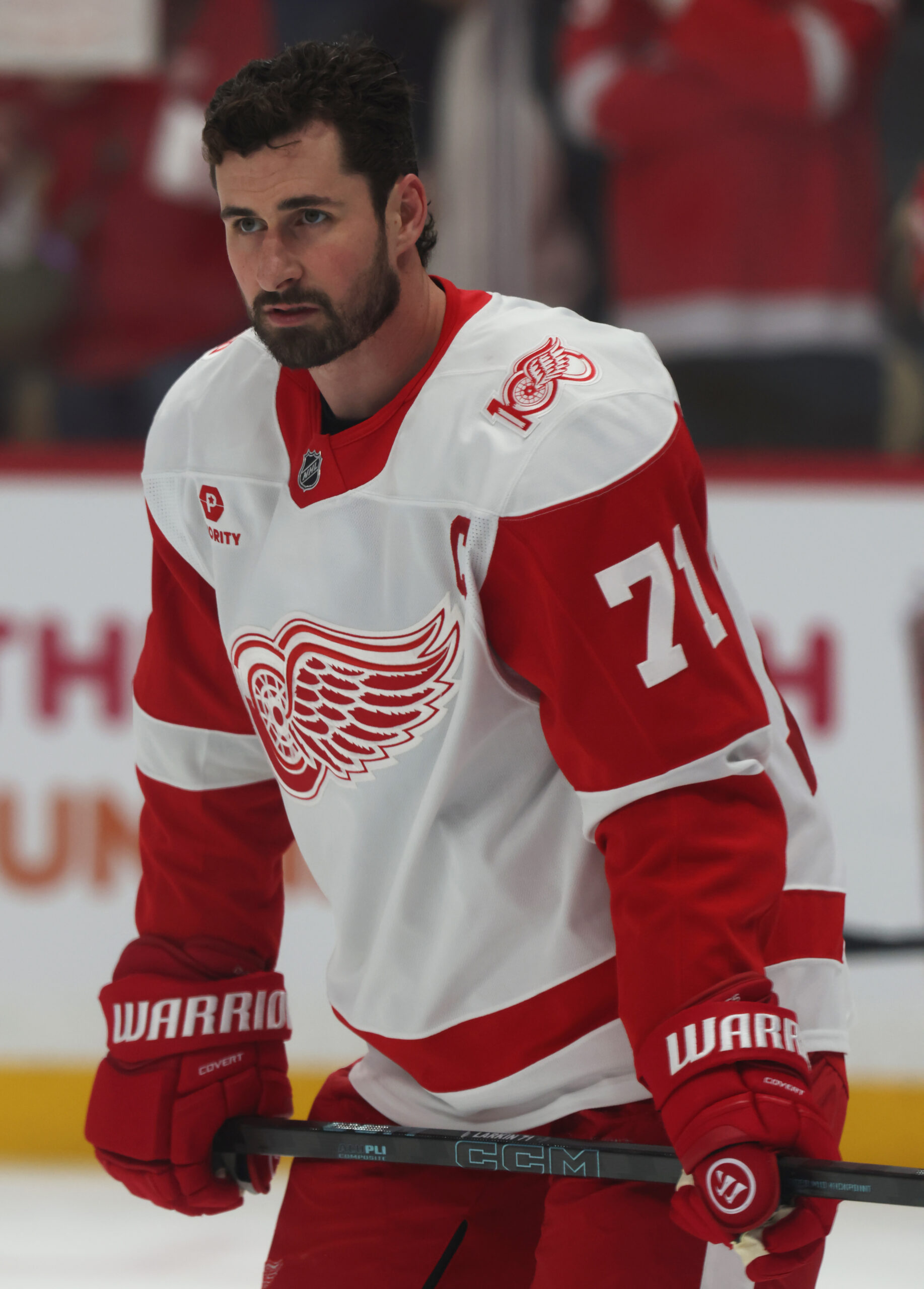
Larkin made headlines at the end of the Red Wings’ season when he criticized Yzerman and the team’s hockey operations department for not adding enough talent at the trade deadline.
In his end-of-season media availability, Larkin told reporters “it was hard that we didn’t do anything,” and “we didn’t gain any momentum from the trade deadline. Guys were kind of down about it. So it would have been nice to add something and bring a little bit of a spark on the ice.”
The Red Wings traded first and second-round picks to the St. Louis Blues to acquire veteran Justin Faulk at the trade deadline. The club also traded a fourth-rounder to the Ottawa Senators for veteran forward David Perron. Those additions were not enough to halt the Red Wings’ second-half slide out of playoff position.
Per Emily Kaplan of ESPN, the issues between Larkin and the Red Wings’ front office “[date] back at least to testy contract negotiations in 2023,” meaning beyond just Larkin’s unhappiness with the team’s work at the trade deadline.
If his request is fulfilled, a Larkin trade would mark the end of the player’s decade-long tenure in Detroit. The Waterford, Michigan native has spent his entire hockey career in the state. He spent his amateur career at the U.S. National Team Development Program in Plymouth, Michigan, his collegiate career at the University of Michigan in Ann Arbor, his very brief minor-league career in Grand Rapids, and his NHL career in Detroit. That Larkin is not only willing to move on from the Red Wings, but is actively pursuing the move, suggests something in his relationship with the team has become fractured – though it is important to stress that is just speculation.
What’s clear is that this will not be an easy trade to complete. That is not because there will not be league-wide interest in Larkin, of course. Roster building in the NHL is defined by scarcity at the center position, and in-their-prime No. 1 centers are very rarely ever available on the trade market. Those factors alone will mean there is likely to be a massive amount of interest in Larkin from across the league. Rather, the path to an eventual Larkin trade will be a difficult one because of the two key parties involved at its outset, and the varying degrees of control and leverage each party has.
Larkin, 29, signed an eight-year contract extension with the Red Wings in March 2023. The deal carries an $8.7MM AAV (which may be below market-value for No. 1 centers at this point) and crucially carries a full no-trade clause through next season. That will allow Larkin to hand-pick what teams he is willing to be traded to.
In the past, players empowered by no-trade protections have been able to severely constrict how many teams their clubs are able to negotiate with, often dramatically reducing what the acquiring team needs to surrender in order to acquire the player. Notable examples of this include this past season’s Artemi Panarin deal, or the trade that brought Taylor Hall to the Boston Bruins from the Buffalo Sabres.
Although the no-trade clause gives Larkin the ability to exert a significant amount of control over the trade process, there are limits to his leverage. Larkin is under contract through the 2030-31 season, a factor that gives Yzerman and the Red Wings a considerable amount of their own leverage. Larkin has requested to be traded, but the Red Wings have zero obligation to acquiesce to his request. He is contracted to the team, and will remain so until his age-34 season. They are fully capable of retaining Larkin through what could be the end of his prime playing years.
That could limit the extent to which Larkin is able to wield his no-trade clause. If he wants to hand-pick his destination, leaving Detroit in a position where they would need to accept a sub-optimal return package for their No. 1 center, it’s likely the Red Wings would simply elect to keep Larkin. But if Larkin does want to be traded as his No. 1 priority, he may need to allow the Red Wings to open up the trade process and allow for as many bidders as possible. His best chance of securing a trade from Detroit could very well be Yzerman simply receiving an offer he can’t refuse – something that is unlikely to happen if he exercises his contractual right to severely restrict what teams he can be traded to.
There is also the chance that Detroit very simply will not entertain a Larkin trade, regardless of the player’s wishes. Teams typically only want to roster players who actually want to play there, but Larkin would not be the first player to make a trade request that goes unfulfilled. While Friedman called the relationship between Larkin and team management “frosty,” it may not be an irreparable fracture. For both Larkin and the Red Wings, the best course of action could very well be staying the course.
For the Red Wings, it’s difficult to imagine them winning a Larkin trade. As previously mentioned, finding a No. 1 center is extremely difficult in the NHL, let alone one who is under team control and within the prime years of his career. Larkin fits the bill there, having scored at just below a point-per-game rate over the last half-decade. The Red Wings are the owners of the league’s longest playoff drought, and are desperate to return to the playoffs after an extended rebuild.
For as much talent as the team has right now – like young stars Moritz Seider and Lucas Raymond – they lack a center at Larkin’s level. J.T. Compher and Andrew Copp are both middle-six types, and top prospects Marco Kasper and Nate Danielson are both considered by most public-facing scouts to have a No. 2 center ceiling. Unless the Red Wings can find a pivot with true No. 1 center upside as part of a return package for Larkin (and the odds of doing that seem long), a Larkin trade could set their franchise back at an extremely important time.
But without question, there will be a lot of interest from around the league to navigate. The Minnesota Wild stick out as a team likely to be proactive in pursuing Larkin. Wild GM Bill Guerin got to see Larkin up close in his position as GM of the U.S. Men’s National Team, and Larkin’s efforts helped the nation secure a gold medal at the 2026 Winter Olympics in Milano-Cortina. The Wild believe they have a championship-level roster, just missing a top-line center to pair with No. 2 pivot Joel Eriksson Ek. Larkin immediately surpasses Vincent Trocheck as the top veteran center potentially available via trade, meaning he will be a key target for Guerin.
Other teams, such as the Montreal Canadiens (who need a No. 2 center behind Nick Suzuki) and Los Angeles Kings (who need help at the position in the wake of Anze Kopitar‘s retirement) stick out as potential bidders. But in the former’s case, the Red Wings may be loath to deal Larkin to a division rival. And in the latter’s, the Kings may not be willing to part with the high-end assets necessary to put together a winning offer for Larkin.
In any case, this is an absolutely seismic development, one that has franchise-altering potential for the Red Wings. If the Red Wings do end up seriously considering trading Larkin, his presence on the trade market will likely shape the course of the offseason.
Photos courtesy of Charles LeClaire-Imagn Images
Best for both sides. Guy isn’t capable of carrying the load. Kind of a shame that he followed up legends of the game like Zetterberg and Lidstrom wearing the C. Hopefully they can get something decent back for him.
He’s an elite 2C on any team. But Could see him with the wild absolutely killing it next to Krill the thrill
He makes a ton of sense for MN. But what can the Wild offer?
Yikes, what a kick in the junk for the fans. I’ve never been high on Larkin and long thought he was out of his depth but it’s pretty sad to step up to the plate and say you’ll be THE guy only to then tuck tail and run. He’ll be a great 2C on a contender.
Out of his depth? His play at 4 Nations and the Olympics would suggest otherwise.
Well he’s clearly failed to lead his team as 1C and captain so… yeah, out of his depth.
That sounds like quite a few teams.
Looking at you Leafs…
So one guy is supposed to carry the team? Okay then…..
How many do you see sign a long term big money deal, become captain and request a trade out within a couple of seasons? I haven’t heard of anyone else in the league…
As the 3C and PK guy? Yea he fits that role very well.
Per the article, the re-signing process was contentious, so this isn’t an out of the blue situation. I wouldn’t have blamed him for wanting out a few years ago.
Leafs? What do they have to offer? Spare me the BeN dAnFoRd nonsense.
If it’s true I wonder if the Hawks would be interested? I suppose as always it depends on what they want but since the Hawks and Wings aren’t in the same conference anymore the rivalry aspect doesn’t matter. If the draft falls their way and the Hawks can end up with Stenberg anyway would they really BE all that interested? This would be a great time to own a crystal ball. He isn’t really the Hawks biggest need but good players are good players. They should at least be in the conversation I would hope. Friedman is at least reliable in these things.
Hawks have a lot of prospects and need good established roster players, he’d be good to either have Bedard on his wing or be the teams 2C and give them much needed depth to finally get them outta the rebuild
Bedard, Larkin, Frondell and Nazar or Stenberg for C’s? I’d put that up against any team.
Sternberg is a winger
Not when he plays with Frondell in Sweden he isnn’t.
They need someone to play D on the team..
Like I said it’s not really their biggest need and far as who plays where on the Hawks I think we’re beyond that point. It doesn’t really matter anymore who plays what, It’s more of a case of who plays better with who. Besides in the NHL today with the rate guys get tossed on Face offs it doesn’t matter a whole lot anymore. It’s more about match ups anyway. Like I also said it depends on what they would have to give up. Might not be worth it. But it could be fun to toss around for laughs.
Knowing Stevie Y we won’t get all that much for him in a trade.It makes you wonder if he’s tearing everything and starting over.
So would Nazar and the Hawks 1st in 2027 get it done? They’re not getting #4 this year. Nazar is signed just as long as Larkin at around 5 million and Larkin makes 9 so only a 4 million dollar pay spike for the Hawks and they get better a little faster. Larkin plays on the PK and he can replace Mikhayev. Hawks still have 2 1st round picks next year( Edm, Fla). Nazar was big at Michigan. Think about and get back to me. LOL
I don’t like the idea of trading Nazar. As I said a year ago, Nazar is a 30/40 goal guy, if he can stay healthy. How about Moore and a first and second?
Right right…bc that makes so much sense…to tear it all down…yeah, Ok…smh
Local guy who is not appreciated by many Wings fans. He showed how great he can play at international play with better players. Larkin would be a great 2C on a good team.
Just look at the comments here
Exactly, so many ignorant fans.
Not true, his bag was being licked by your typical “Hockeytown Fanatic” Wings fan, which is most of them. But anyone who played, knows the game, and looks at the little things that seem trivial know he’s not the one to lead. Solid player but not “the guy”, just a guy.
7 more years of rebuild for Detroit
Dvorsky, No 11, and No 15
Actually he’s older than I thought. Blues probably don’t want a 30 year old,
Yzerman can’t draft. No picks just players
Who do you think drafted Kucherov and Point for TB?
Ummm…the Lightning scouting staff??
Is this a trick question?
Kyrou and pick number 15. Is that enough? 15 was originally the Wings pick.
Scouts found those guys, not Yzerman.
Here comes the my teams garbage for your top player on a good contract trades
To the Canes for Svechnikov.
Sent Yzerman an ultimatum: it’s me or it’s you??
He was literally a star at the Olympics. Detroit is going to realize just how good he is once he’s gone. A true 200 ft player.
Yeah I can sort of see how he might rub some people the wrong way but I’ve always been pretty high on him. Not a super elite build your entire team around type of guy but certainly an excellent player. Will be interesting to see how he fares in a different environment.
I’m thinking that the average Wings fan would have preferred that Larkin be more of a star for THEM rather than for the national team.
Matty Beniers and Ryker Evans for Larkin and a pick, 2nd or 3rd round? Nobody’s taking Stephenson’s contract, not even Yzerman. Doesn’t solve all of either team’s problems, but it helps both. The kraken actually have a lot of young promising forwards they can deal from. Would hate to see Shane in a red wings sweater though.
Not sure Larkin agrees to go to Seattle. He might give the Wings multiple teams he would go to, but I’m sure there are teams that he would use his trade protection to nix a trade. I feel like Seattle would be one of those teams. Going from one team who can’t make the playoffs to another doesn’t seem like what Larkin would want
LOL. That wouldn’t even get them on the phone.
I don’t know the full story on the matter but it appears that turmoil is possibly brewing in Detroit if even their captain, Dylan Larkin, is seeking a way out. His departure could potentially trigger a domino effect, prompting others to follow suit. We shall see how it unfolds as I didn’t see this coming.
On a side note, this situation seems perfectly aligned for Minnesota to step in and secure Larkin.
He is tired of the 17 year Yzerplan
PHLY is my guess where he will end up.
I’d be happy
I saw this coming the moment #19 became GM.
Is it April 1st today or is it real?
Real question is will they move Seider and rebuild if Larkin is gone? Or will they try to re-tool around Seider?
Brayden Point for Larkin. Fresh start for both !!
Wings have multiple first round picks who are now breaking into the nhl. Losing Larkin might set things back a little, but could benefit the Wings depending on the return. There is no need to move Seider, he is the cornerstone.
Jarmo has an aggressive reputation, and the Sabres are a young team that could appeal to him. Norris is another Michigan native that would be a 1C replacement for Detroit.
Norris’ injury history might make him expendable and the salary comps. gets BUF in a position to make it work. The Sabres have a very deep D prospect pool. One of them plus Norris could give the framework +/- for a deal.
Norris and Power would do it. Sign Tuch on July 1 😆
Maybe keep Norris despite his injury troubles he does win faceoffs, Buffalo was willing to offer Mrtka in a deal for Parayko and Detroit won’t have any leverage here so how about this
Buffalo: Larkin, and Cossa
Detroit: Mrtka, 1st 2027, and Power
Buffalo can make a LHD expendable especially when already having Dahlin, Samuelsson, and Byram ahead of Power, Power does have plenty of potential so the Wings would like this return, the 2027 1st will be closer to a 2nd rounder anyways i feel this balances
You are a little light, add Kulich and it is a deal!
Buffalo! For Norris, 1st, 2nd and smth else.
Surprising to hear, but good news another 1C is potentially available other than AM for the Flyers to pick up. Hoping for a big swing this summer from Briere but likely gonna be let down lol.
Flyers certainly have the assets to make that deal.
Gotta see where Larkin will agree to go.
I get the feeling he won’t hamstring the Wings by agreeing to just 1 destination.
Wild, Avs, Dallas, FLA, TB,Montreal, Canes at the top of the list, Maybe Boston, NYI, Utah.
The guy gets hurt every year and as a captain has been unable to motivate his team. Put him on trade block now and let the bidding war begin. Other teams that are close to making a cup finals will give up a lot for a controllable two way center. Let him be there underachiever.
Yeah sure but Red Wings are not in a position to trade their 1C for futures. Most of those teams can only trade away futures and he’s a center which will have to be replaced in a market where there’s no comparable players rn. I don’t see any way Yzerman walks out of this on top
In the past 5 seasons, Larkin has played in 71, 80, 68, 82 & 74 games. That’s hardly a guy who is hurt alot.
Larkin has every right to ask for this trade and criticize the Wings for how they’ve done things. Nothing more he could’ve done to advance that team.
I’d love for the Preds new GM to try and acquire Larkin. They’d immediately be a playoff team with him in the mix. The Flyers will no doubt be in on him and I can definately see Guerin making a play for him as well.
Is a good player but not a bonafide superstar captain, he’s not the guy to lead any franchise. Just a solid tool in the tool box.
Doesn’t need to be a superstar, but any team can use a 30G 70pt two way player like him.
I can admit he’s a good piece to a contending team, he’s just not someone you build a franchise around, which is what was expected of him in Detroit unfortunately.
Well, if you’re building a team around a #15 overall pick, you’re likely making a mistake. He’s a good piece of the overall puzzle, but certainly not thee piece.
@chip So he’s not the guy? Can you name 32 1 line C who are better?
I can name 16 who are better, they made the playoffs.
Tell that to Ken Holland.
So you would take any of the Flyers centers over Larkin? Okay then…..
@gbear thats what i’m saying. it’s a low iq input. If Dvorak is your guy over Larkin, if its Schmaltz, Hartman, Kopitar, Zacha, Hintz only then it makes it 16. It barelly makes it 16 league wide. None of those smart guys would take Dvorak over Larkin
You guys are over analyzing the f**k out of this, chill out. Yea ok I wouldn’t take Dvorak over Larkin, but there’s other 1Cs who didn’t make the playoffs that I would take over Larkin. So he sort of sits in that middle of the road 1C, high level 2C. In a trade could easily get a guy who is nearly as good as him, along with another depth player and something else probably to sweeten the deal. You can’t have an immature sour puss be your leader, just can’t.
If a player is content with missing the playoffs every season, then I’d rather have some “sour pusses” who aren’t content with that.
@Chip Its for the sake of the argument all cool
Your interpretation of Larkin’s character is wild. Crybabies don’t lead a team to a ship. He’ll do fine on another team playing second fiddle to someone else though.
The only one crying here is you, Chip.
In a way we’re both crying, you’re crying about how good he is and I’m crying about how overrated he is. I’ll accept that.
Dylan Strome + 2026 1st in a swap of miscast 2Cs. Caps get the better player, Wings get the better value.
and Strome reunites with DeBrincat and Kane from their Chicago days
given Detroits lack of leverage here id say Protas, McMichael a 1st in 2027
Protas isnt a 200 foot player and inconsistent which wouldn’t be missed, offer up depth guys and keep Strome especially after putting up over 70 points at a steal of a deal at $5.5M AAV, would definitely better the Caps chances if Ovi wants to take another crack to win a cup
Chicago should be all in on him
Jordan kyrou and a 2nd rounder. Or buchy and a first rounder
I like Buchy and a first rounder since we have 3 in the 1st.
It’s so CRAZY that it MIGHT just work…
Larkin
Raymond
Sandin-Pellikka
for
Matthews
Knies
Rielly
The soap operas for both teams can be over.
Just need the Leafs to throw in Nicholas Robertson so we can officially have the Detroit Red Maples.
Kind of a pretty sweet name though.
I’m still trying to get over the Marcel Dionne situation
Now that’s holding a grudge! 😄
Dunno, are you guys going to give Dale McCourt back?
This is where the CBJ swoop in and overpay
haha they will not give ’em Fantilli!
The Pens have the ammo to acquire a big name. But, hopefully, not this one.
Why? Too young?
Captain who is quitting on his team. Never won a thing. Never lifted his team to anything. About to turn 30 making big coin. Better options to be had with limited resources. I could go on…
I have always been a Larkin skeptic. I remain one.
He just ain’t “the guy”. Good player but not top tier.
Never lifted his team? He just won gold at Olympics. Lol. He’s elite 2c any team could use him. Wanna name a player whos younger, better and cheaper and could get got?
Yeah, he sure carried that squad on nobodies on his back.
Also, if a 3 on 3 OT (might as well play high card or flip a coin) goes the other way, no one ever cares about that team again.
Listen, if you like this player, maybe your team will want him. (Unless you are a Wings fan steam cleaning a leaking engine, of course.)
I don’t like this player and I don’t want my team to get him.
I love how you downplay his role on a gold medal Olympic squad of best in the world. How many games u have? How many goals? You’re just incorrect abt your analysis and your reasoning is bogus. But since you state that you just dont like the player… At least its honest
I don’t think you actually love how I downplay his role.
If he’s so great, keep him or get him.
No interest here.
So winning Olympic gold is nothing now? Wow dude ure tough! Dude there’s no reason trying to challenge @Wilf for the throne of laughable takes here. U cant unseat him even if u say that McDavid is washed up.
You could actually type using intelligible English, for one. But that aside, no, winning Olympic gold is not nothing. It also — wait for it — *has nothing to do with the National Hockey League.* There are a whole whopping lot of Detroit fans who don’t give a flying eff about the medals in Larkin’s closet, but who care a whole lot that he hasn’t led them into so much as a playoff berth.
(By the way, he didn’t “lead” the US Olympic team, either. Quinn and Jack Hughes were USA’s leading scorers. Followed by Austin Matthews, Jack Eichel, Zack Werenski, Matthew and Brady Tkachuk … and, y’know, a fellow by name of Hellebucyk had something to do with it too.)
I never asked for your low iq input on any subject for one you can give out your free english lessons to smbd else for two you completely missed the points i made thats three
9 year olds really love Dylan Larkin.
Yeah and you like old farts we’ve already established that. Care to answer my question on the topic: can you name 10 players who are younger better and can get got for 1/2 C position for your Old Fart Penguins? Just dont go silent bc i know you like not backing up your babbles
He’s not a 1C for Detroit, that’s why they never won a thing with him.
Can you read? Can you actually answer MY question? You keep sliding off topic might as well just keep your lid on and not babble things you cant back. You comment abt him not being a 1C makes no sense in a real world where NHL teams dont have abundance of players like MacKinnon
No one wants your used car and you are mad, we get it, but yelling at the customers how great it is as they walk off the lot isn’t going to close the deal.
We have all seen the decade long test drive.
Wow i sent the dude to anotha dimension. He’s talking cars
My bad, I forgot 9 year olds don’t understand analogies yet.
Another day another old fart babbling and not backing his words
You have a whole thread of people saying “Larkin? Meh.”
But, you have crusted over that Larkin poster on your bedroom wall so much that you can’t see clearly.
You made a silly statement then i asked you to back it up and you folded. Got nothing to do with my Larkin obsession
Larkin is good NOT great, it’s that simple.
You appear to think I answer to you. I don’t.
He is an OK #2 center being paid Sid money. Lick his sack all you like and enjoy.
Ok now it dawned on me. You really cant understand what i’m asking you because you’re low iq person. It’s so good that this site is inclusive and nobody here discriminates againat low iq ppl. You just need to put a tag near your handle so next time i know whom im talking to. You’re top low iq person of the month! Heres your badge
Imagine loving Dylan Larkin this much.
You want to have his babies.
He’s all yours, Champ. No one else will ever love him the way you love him.
You know how it is, 66. Illiterate trolls are gonna troll. Let’s leave the knuckledragger to have his fap fest with that bedroom poster and move on.
If smbd online writes “u” instead of “you” it doesnt make them illiterate. Welcome to the internet old farts! You guys are so out of depth on every subject that you post abt it’s crazy
It makes sense now the only people who like Larkin are 15 years old, the same goes for Walman.
Chip has to resort to insults now due his arguments having no validity to them. Good stuff.
What have I said that isn’t valid? All of us are just voicing subjective OPINIONS.
Funny, I have not seen anyone suggesting LA as the Larkin landing spot.
Holland drafted him and the Kings certainly need a #1 C, and they certainly should not put Byfield in the return. But considering their need could they have a heavy enough return w/o a very good C coming back that would make Y take it?
In all honesty it wouldn’t be a big loss! He doesn’t deserve to wear that C DeBrincat should be the captain!
Is it low iq bait?
This is the trade that will transpire:
NJ gets Larkin, ASP, Cossa and a 3rd
Detroit gets Hischier, Nemec
NJ gets the cap relief they need with being able to put ASP in the minors and not have Nico’s next big contract, enabling more space for Quinn to arrive. NJ also gets an NHL ready BU in Cossa I believe he can start in the minors if necessary but will require waivers if called up to go back down.
Detroit gets a better C and an NHL ready RD and has the space to sign both.
The idiot second Boston Globe hockey columnist went all googly eyed and suggesting trading Pavel Zacha, Will Zellers AND two first rounders for Larkin, because the Bruins need a 1C so badly … I just stared at that sentence and wondered when he’d lay off smoking peyote before writing columns.
Cool! Feel free to tell us every instance you read some stupud article written by a mid wit on the internet!
Aren’t you chattering on a site where most of the content comments off of articles/social media feeds?
I dont sit reading stupid articles by stupid hockey pundits and emotionally invest in them as much as i have to let the whole world know how i felt when i was reading them and you sir got butt hurt
Nah you just make up stuff all on your own from Moms basement.
@unc when are u gonna get smth new for ur repertoire other than moms basement? Its so stale. Dont you need to keep ur old fart friends entartained?
I just follow the natural progression. Illiterate = uneducated. Uneducated = unemployed. Unemployed = A lot of free time with no money to spend. No money = time on free media( Hence no subscription here). Illiterate + No money+ Free time + No rent money = Moms basement.
Mister you write paragraphs of text to me. Talk about ample free time and unemployment lol. I wasnt even talking to you
If you make stuff up to post on here it’s free for everybody to read and ridicule so I did. Don’t care who you were talking to. Plus Nha is so much smarter than you it’s silly.
Granpa take your pills and chill go lube your m16
Cossa Larkin for nurse a 1st Beau akey Quinn Hutson
Even as an oilers fan this is so lopsided it’s not even funny. Why would the wings get garbage for gold?
Dude is a 2C who thinks he’s too good for the 1C role on a bad team… Yikes.
Not exactly a fan of Detroit’s roster, but this guy is huffing paint.
Yzerman has flat out failed. I don’t blame him Larkin for wanting to move on. No help, no chance to succeed.
The Red Wings need to be torn down to the studs and rebuilt. Problem is the guy who created the need for the tear down is so far the guy in place to do the rebuild.
Larkin was never a number one center. However, he was a dependable player, but not ready to lead a team. Up to Yzerman now it’s make it or break it. He has been a disappointment as a GM.
I’d like to see an announcement from the Wings today saying that the “C” is being removed from Larkin’s sweater going forward effective immediately.
I think the point was that they are going to remove the Red Wing Logo from his Jersey.
To Seattle for Wright and Nyman so he plays for Dan Blysma his former assistant coach in Detroit.
Just read an absolute ludicrous article that suggest Dylan Larkin would not fit with Blackhawks timeline to compete, suggesting he would be in his mid 30’s before they would do so. It also goes on to mention how Matthew Barzal could be an option for them…Larkin and Barzal are the same age…
Personally, as a Hawks fan, I’d welcome a Dylan Larkin to my team. He only makes you better.
Ugh. There’s no team in hockey that’s further than three years from respectability, and Larkin’s not yet thirty. A lot of us are dissing him, but that’s just because of the pretensions of being a 1C when he’s really a quality 2C. The guy’s abilities aren’t in question, and any team could use him. He’d certainly be of use to Chicago, if the price wasn’t exorbitant.
This has Wild written all over it. They need a goalie Wallsted , young cheap center Yurov and then throw Hartzy in , he will do good on his contract year.
Larkin will get to be 1C where as everywhere else would be 2C.