
The offseason has arrived for half of the league’s teams that aren’t taking part in the playoffs. Accordingly, it’s now time to examine what they will need to accomplish over the coming months. Next up is a look at Calgary.
After a late-season push in 2024-25, there were some in Calgary who hoped that the Flames would be able to take another step forward and get back to the playoffs. Instead, the firm realities of a rebuild set in, with the team ultimately jettisoning their two top defensemen and number one center. There is a lot that GM Craig Conroy still has to do although with 2026-27 expected to be another tough year in the standings, the biggest work isn’t in the cards this summer.
Keep Stockpiling
Last summer, the Flames only had one extra draft pick but it was an important one in the form of a first-round selection, albeit at the end of the first round. It was the second straight year they had an extra pick in the opening round after nabbing Zayne Parekh and Matvei Gridin in 2024.
As things stand, that will extend to three years as Calgary has an extra first-round selection (Vegas), plus three extra second-rounders that in theory could be packaged to try to land another day one pick. They also have extra firsts in 2027 and 2028.
That’s a strong foundation of draft picks to work with although that’s only part of the battle. They also need to keep adding more drafted prospects that are closer to being NHL-ready to their pool. Those players would then represent the next wave as more veterans are cleared out over the next couple of years before the high volume of draft picks yield players that will eventually be ready to push for playing time. Calgary has done well there lately as well with the additions of Abram Wiebe, Jonathan Castagna, and Tyson Gross over the last few months.
Will there be a logjam down the road? That’s the ideal plan, giving the Flames extra depth to deal from at the time that they should be flipping the switch from their rebuild to trying to contend. So, for now, there should continue to be an emphasis on not just quality but also quantity, allowing a deep stockpile to get even deeper. Continuing to add center depth would be particularly wise.
Cash In On Coleman
Heading into the trade deadline, there were questions of how many more veterans would be heading out the door, joining Rasmus Andersson who had already been moved to Vegas. MacKenzie Weegar ultimately was moved to Utah while Nazem Kadri wound up back in Colorado. But there was one veteran of significance who was drawing significant interest who didn’t move, winger Blake Coleman.
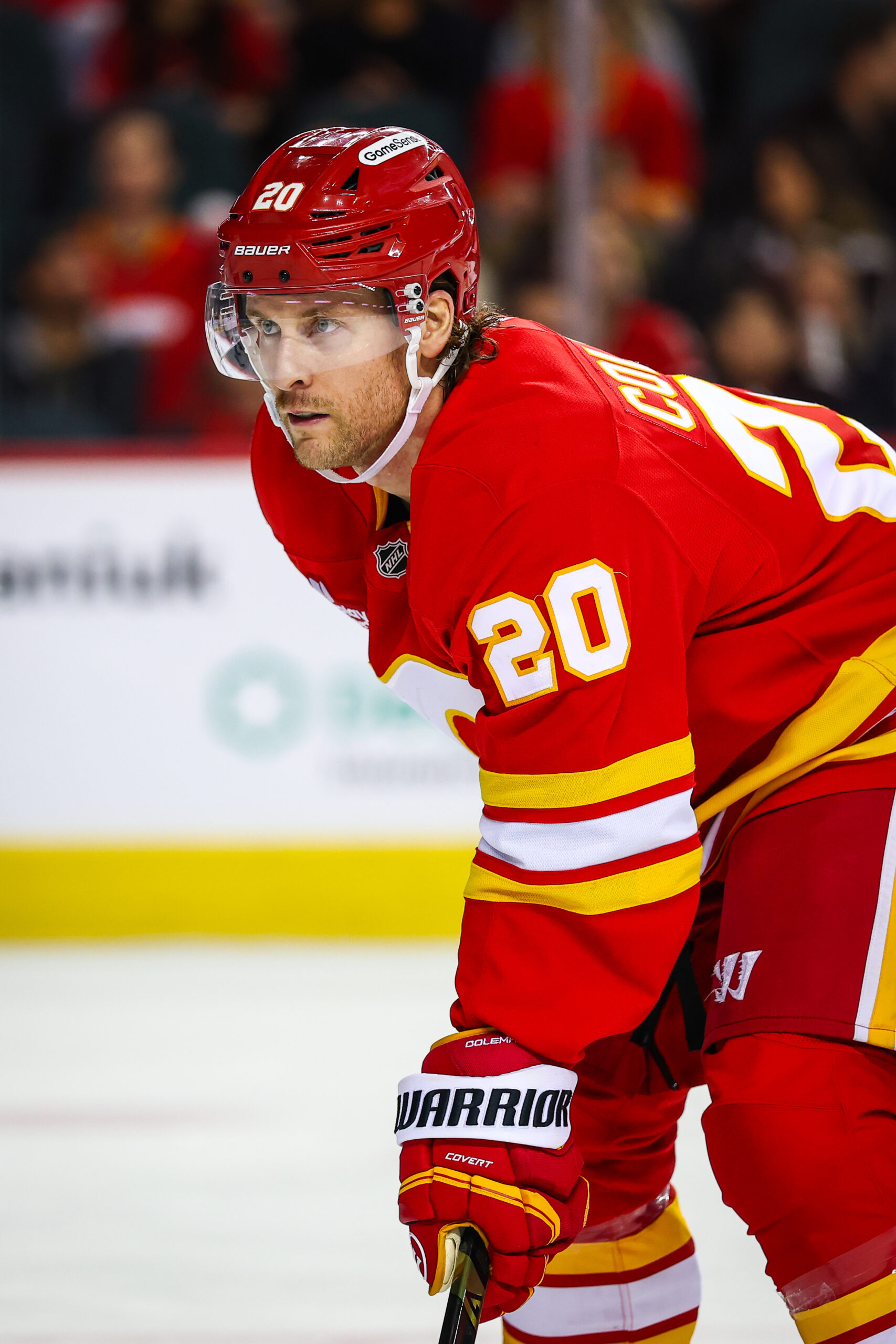 While there’s something to be said for having some quality veterans to work with a young core group, there’s also something to be said for not cashing in one of their top trade chips. Yes, his contract is on the pricier side for a player who has only reached the 40-point plateau once, but with the salary cap set for a big increase and a fairly thin UFA market, $4.9MM for one season is a price tag that a lot of teams should be able to afford. (And if not, Calgary gets two salary retention slots back on July 1st which could be used to get something done.)
Down those retention slots back in March, it’s understandable that Conroy opted to pass on moving him as in theory, the return should be better with part of the contract paid down. It’s also understandable that a team would want some quality veterans working with an increasingly younger core group. But Coleman is also one of the few veterans remaining that could plausibly yield a return of significance. It’d be hard to pass that up for extra mentorship in the room. Yes, they could wait things out and see how things look at next year’s deadline, but if there’s a strong return out there this summer, that might be the right time to take it.
Add Serviceable Veteran Defender
If Conroy is concerned about a dearth of quality veteran leaders in the dressing room following the recent exodus of players (and the potential move of Coleman), there’s nothing stopping him from trying to add one via trade or free agency. And if he wants to do that, looking at the back end would be a good idea.
While Calgary did receive veterans back in the Weegar (Zach Whitecloud) and Weegar (Olli Maatta) deals, neither of those players are ideal top-half pieces in the lineup. Whitecloud, meanwhile, had a strong market at the trade deadline and is a plausible candidate himself to get dealt over the summer if the Flames want to cash in on his elevated trade value. Those two were basically top-pairing players down the stretch with Kevin Bahl getting nearly 22 minutes a night as well.
Meanwhile, their depth isn’t the greatest either. While they have high hopes for Zayne Parekh, and Yan Kuznetsov impressed this season, Brayden Pachal and Joel Hanley are next on the depth chart. Those are more fringe/depth pieces than full-fledged regulars. They could be upgraded on with another serviceable veteran or two that raises the floor of the group to move it to more of a by-committee approach which probably better suits this roster.
Fortunately, depth defenders are a lot easier to find than top-four pieces, ones they’ll have to trade for at some point when they’re closer to ending their rebuild. But a good veteran or two on the third pairing can help fill some of the leadership gap and perhaps even give them some chips to move closer to next year’s deadline. While rebuilding teams often aren’t looking to get older, Calgary could buck that trend with the right veteran blueliner or two.
Work On Frost Extension
Last summer, the Flames elected not to work out a long-term contract with then-RFA center Morgan Frost. Having just acquired him from Philadelphia earlier in the season, they wanted to get a better sense of how he’d fit. Accordingly, he inked a second bridge contract, a two-year, $8.75MM agreement. On July 1st, he’ll be extension-eligible and now armed with more information about his fit on the roster, Conroy should be looking to get something worked out.
Frost only managed a dozen points in 32 games after being acquired last season. However, a full training camp and season in Calgary’s lineup seemed to get him going again. Frost played in all 82 games this season for the first time in his career, scoring a career-best 22 goals while adding 21 assists in 15:30 per night of playing time. He also won nearly 57% of his draws, also a new personal best.
While Frost doesn’t profile as a top-line pivot by any stretch, he should have plenty of years ahead of him in a middle-six role. While that’s not necessarily the type of player teams will generally want to commit a long-term contract to, Calgary’s dearth of center options could force their hand. Kadri is now gone while captain Mikael Backlund is 37 and is nearing the end of his career (though he begins a two-year deal next season). Ryan Strome is also in the fold but is more of a reclamation type of project.
Yes, the Flames have high hopes for prospects Cole Reschny, Cullen Potter, and newcomer Castagna. However, those players are a while away from making meaningful NHL contributions. Frost is a logical fit to try to keep around for a few extra years beyond 2027 to serve as a bridge to some of those prospects.
Given that he will be an unrestricted free agent next summer and the big projected increases to the salary cap, it’s fair to say that Frost will be in line for a bump up on his current deal. An increase into the $6MM-plus range feels doable and with their long-term cap situation looking quite strong at the moment, it’s a price tag they can afford. Rather than wait it out another year, it might make more sense for the Flames to get this done this summer.
Photo courtesy of Sergei Belski-Imagn Images.
Draft capital and solid vets in returns. Very impressed with Conroy on his vision. Unlike Treviling…it seems that the Flames have a GM with actual vision.
Mm, I think they need to do something with Coleman *this* summer and not wait until the deadline. He’s already 34, and the underlying numbers are in decline. Better take what they can get now and not gamble on future performance. With that … I’d have to think with how thin the UFA market is looking that they can get a decent return.
Yeah there should be a pretty good market for Coleman. Maybe another 1st and prospect? I’m thinking Dallas could really use him right now. I think a team will feel that he is a missing link for a contender.
I suspect Dallas will try and shed a little salary if they give Robertson his massive (and deserved) extension.
Will they finally get the 1st overall draft pick?
Toes and fingers are crossed. With the new building coming…maybe the hockey gods will finally grant the Flames a hand up.